Showing posts with label exhibits. Show all posts

Wednesday, September 23, 2009

What aesthetic does a prototype need?


By Maria Mortati, Sr. Exhibit Developer
Should a prototype exhibit or space in a museum feel as refined as possible, or like an experiment?

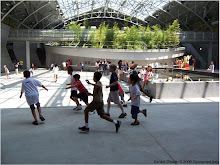
We've been working on this with a client who is starting to test out ideas (as well as themselves) through prototyping. The Fort Collins Museum and Discovery Science Center merged last year, and while they are in development of their new facility, they have moved in together. They are smartly using this opportunity to test out new ideas, their relationship, and inviting the public in to participate. 

One question that's come up is what should this look like? Does it want to look like a finished exhibit? 

Our recommendation is that it is more inviting for visitors if it feels like a prototype- leave things unfinished (but safe) and loose.  For example, print out graphics and clip them up, leave the walls bare white or unfinished. Clamp on lighting- you get the idea. 

This creates an environment where both ends of the relationship can take risks and have permission to mess up and iterate.

Our experience is that the visitor will be more open to raw ideas presented if they come into it as an invitation into your experiment. They can feel like they are a part of the process at the museum. Which they are.

You can also invite them to come back and be a part of the testing and development as things progress. A great vehicle for repeat engagement. 

We're excited to see how things progress, and we'll report back from time to time as things progress. This is going to be fun.

Friday, December 12, 2008

Museums Now: Museum + LEED Friday: making sense of certifications [Part 2]

LEED, museums, stewardship, certifications, green materials, sustainable practices, gyroscope inc, maria mortati, museums [Hi, Scott posting again] To follow up on the material certification topic I started last week, this week I will be talking about Cradle to Cradle certification. "Cradle to Cradle" is a term coined by William Mcdonough and Michael Braungart to describe a pretty radical way of thinking about the life cycle of a product. Cradle to Cradle is about creating products that are designed for closed loop systems that create value and are healthy and safe. Often as a product moves through it's life cycle it goes through a dramatic degradation process and it's value becomes trapped in useless waste or worse yet it harms other natural systems as it is used. The bigger goal here is to design products that beneficial when they are used. He makes the point that growth in nature or a child is a good thing and so why can't growth related to development also be positive? This thinking turns the minimizing approach of sustainability it's head says that consuming product should play a positive role in our environment and society. The funny thing is that while this will require a radical reworking of the way we think about making and using products, it allows our consumptive urges to continue to run wild. For me, this is both the most promising aspect and the biggest danger. Our consumptive desire has been a tough one to shake (if not impossible) and while the bright future of good products sound great, in the short term we will have to do less. Anyway William McDonough along with Michael Braungart have written a really good book covering this approach and have followed that up with a certification program that evaluated products against their criteria. Mc Donough's website has videos and writings that are worth spending some time on. One interesting development with the LEED certification is that the next version (New Construction V2009) it will contain life cycle assessment as part of it's criteria. I will be interested to see if they start embracing ideas similar to Cradle to Cradle and then I wonder how such a potentially wide reaching idea will impact their other criteria.

Friday, December 5, 2008

Museum + LEED Friday: making sense of certifications [Part 1]

LEED, museums, stewardship, certifications, green materials, sustainable practices, gyroscope inc, maria mortati, museums [Hi Scott Moulton posting.] With all the focus on "green materials" I thought it would be useful to talk about a few of the certifications that relate to materials . I'll start this week with certification for wood. Ok first I'd like to make a pitch for solid wood. It is a beautiful, durable, natural material that can be sustainably produced and will biodegrade. After building furniture with it for about 10 years I am still totally enamored with solid wood. (plywood is another matter) So if you are like me and want to use wood and wood that is sustainably forested you will be seeing the logos of FSC and SCS and trying to make sense out of what they mean. The Forest Stewardship Council is an independent, non-governmental, not for profit organization established to promote the responsible management of the world’s forests. They are the ones who set the most widely accepted standard as to what it means to call something sustainably forested. They have established 10 Principles and 57 criteria that address legal issues, indigenous rights, labor rights, multiple benefits, and environmental impacts surrounding forest management. I've always been impressed by their commitment to a rather broad interpretation of what sustainable forestry means. A lot of the exotic woods come from some troubled regions of the world so along with ecological concerns come some even more serious issues around the impact this trade has on the local people. SCS stands for Scientific Certification Systems and they provide independent third party certification for everything from coffee to flowers. You can see a wood product with both the FSC and SCS logos or only one which has always been a bit confusing to me. The thing to remember is that SCS is primarily a company that verifies environmental claims and performance based certification. So SCS verifies that a forestry practice adheres to the guidelines set out by FSC. Now things get messy because SCS also has their own competing guidelines which they will then verify and you can have the SCS logo show up. In addition, they offer Chain of Custody Certification, Life Cycle Assessment (I'll get into this next week) and single attribute certification for terms like salvaged recycled recovered and so on. All of this points to the interesting fact that while FSC certainly has established itself as the standard, there are differing views on what "certified wood" can or should mean. It is worth investigating the SCS website. I'm still trying to get my head around the extent of everything they are involved in and it raises interesting questions. Is it ok that these "independent third party" folks are also helping Starbucks and Home Depot set up eco guidelines that they will then use as marketing? While it may not be the purist path, I think this work with huge corporations is a really promising development. As ecological concerns become mainstream they will become part of our broad economy the commitment to verification and standards is critical to preserving some meaning behind terms like of "eco, sustainable, or green".

Friday, October 31, 2008

Museums + LEED Fridays: Green Exhibits?


[Note: Scott Mouton recently posted this note on the ASTC Listserv in response to a discussion about "green" exhibits. I thought it was an excellent discussion of what LEED credits mean in this context. -Maria]
On a basic level LEED is a way to quantifiably measure a building's performance in relation to the criteria set out by the USGBC. Buildings are LEED certified but not products, materials or people. This is not to say LEED has no bearing on exhibits. There are ways that exhibits can contribute towards points and the credit intents are a great way to inform a sustainable strategy for exhibits.

One thing that often gets confused is that materials can contribute towards a credit but
they are not in and of themselves certified. This might seem nit picky but it actually brings up an important aspect of LEED. The system evaluates the entire project based on a set of criteria that is a bit complex and often times contradictory. This complexity within their system is necessary and good.

As soon as you try to say something like "plyboo is a green material" things get complicated. It is a rapidly renewable resource but it also comes from China so it requires a great deal of energy to ship. At almost every turn you can find more questions than answers when trying to find something that is unequivocally "green". Instead of focusing on absolutes, LEED established a clear intent for each credit and then the sum of the credits gives an indication of the overall performance with regard to the environment.

For instance LEED has a credit for using rapidly renewable resources for 2.5% of all the construction materials (plyboo applies here) and it also has a credit for using regional materials for 10% of construction materials.

As the conversation about what make an exhibit "green" evolves, I hope it will broaden beyond material choices and focus overall sustainable strategies. As was raised in an earlier note, there are so many ways to look at this issue. Focusing on the entire life cycle of an exhibit will give you a different set of criteria (and thus end result) than if you were focused on carbon footprint. How do we establish this criteria and then what does it say about us? What are we willing to overlook, what tradeoffs are we willing to make?

So far the discussion has focused on the built object, but there is also the content of an environmentally focused exhibit to think about and how to engage the visitor in these issues. The social space of the museum could also offer unique ways for visitors to experience the aggregated impact of their decisions and sense community that can come from acting collectively.

Oh, and my choices for countertops typically *marketed* as green are:
  • sustainably forested wood (if it is an appropriate application)
  • Colorlith (recycled pulp in concrete)
  • Recycled glass (if you can afford it)

-Scott

Tuesday, October 21, 2008

Web 2.0 Sessions at ASTC

By Maria Mortati
I went to a few web-related sessions at ASTC that brought up some interesting questions and case studies.

Bryan Kennedy of the blog Science Buzz talked about the Body World Exhibit blog at Science Museum of Minnesota (SMM). They used the opportunity of the show to look at issues around body donation and asked questions of ethics (and beyond) via the blog. In using this example where they opened it up to be "messy", Bryan was trying to get the audience to consider what their comfort level is with things like controversy when setting up a 2.0 outreach tool.

Kevin Von Appen of RedShiftNow posed the question of "How do you make the virtual audience physical?" He gave a case study of a world wide YouTube event and subsequent real world "888torontomeetup" they held at Ontario Science Center, and how popular it was. While they didn't end up covering a lot of science, it brought in a new audience to their museum, and created a memorable (and heavily archived) connection.

Nina Simon of Museum2.0 gave a really fun example about how to do "tagging" in the real world. It's about a book drop in the Netherlands where folks returned books into one of two slots: average books and great books. She wrote a fantastic blog post about designing from a virtual metaphor to a real world experience.

Other topics covered, such as:
  • On a museum website or blog, should you make the "official" voice visible? (yes, usually)
  • In terms of child safety and museum sites, they suggested that you don't ask "problem questions" of kids during the log in to avoid issues such as COPPA conflicts later.
  • On extending the visit: the Franklin Institute (I think) has a face aging interactive on the museum floor that posts the picture on the web site. 75% of visitors log in from home to retrieve it. What a great opportunity for them to ask provocative questions about their thoughts on aging, plastic surgery, you name it. You could enrich AND extend the museum experience.
In the session Making Exhibitions Memorable that I cartooned about yesterday, Renato Valdes Olmos discussed how exhibits have permanence, but little reach outside the museum walls. He reinforced the importance of following those who are blogging or flickring about your exhibits, because again, that extends their reach, and leaves a record. He brought up the artist Banksy, who made a fictitious pet store exhibit and how word spread in a viral fashion via Twitter- which got people to go find it. That approach might not play out so easily for a science museum with a permanent collection-- the Banksy piece is a temporary art exhibit.

The thing I keep hearing is this: provide multiple vehicles for visitors to comment and spread the word about their experiences at your museum. Listen to what they are saying, and respond. The interaction itself will provide great fodder for expanding your relationship with your visitors, and in turn, your impact on their lives.

For me, this boils down to being open, hospitable, and responsive-- and utilizing web 2.0 to do it.

Tuesday, October 14, 2008

What Makes a Great Master Plan - the basics

maria mortati, gyroscope inc, museums Last week, I had a conversation with Chuck Howarth, our Master Planning Guru. I wanted to know what are the basic elements of a great plan. Given that this is a big part of our what we do, I'll go into greater depth in future posts. For now, let's start with the bones:
  1. Definition of the audience. Who will come, and how many? Demographics.
  2. Definition of the program. Why will they come? Exhibits, education, theaters, outreach, web.
  3. Architectural concept and site. Where will they come? How can the building reflect and support the mission and program?
  4. The business model. How will the museum support itself? Earned income, support, philanthropy, endowment... What is the relationship between the business model and the service model (item #2 above)?
  5. The capital budget. What's it all going to cost to put the plan in place?
The master plan generally addresses all aspects of the project EXCEPT fund-raising feasibility, which is usually handled separately. That's partly because it is a very different discipline, and partly because of the inherent conflict of interest in having the same team evaluate both the likely cost and the likely resources. When I pressed about "greatness", here's what he had to say:
"Now as to whether it is a GREAT master plan—guess that would depend on doing all of the above well, but also doing them all together. Each feeds back on the other. The program affects the staff plan and operating budget; the capital budget influences the architecture and exhibits; the audience affects and is affected by the program and the business model. And so on. The most common mistake is to treat each topic as more or less discrete, for example by trying to estimate attendance before studying what kind of museum and what type of program. So the plan needs to be holistic and address everything at once. And do it with substance, style, careful research, and creativity."
Thanks, Chuck!

Monday, October 13, 2008

Exhibit or Exhibit Platform: which is right for your museum?

maria mortati, gyroscope inc, museums What is an "exhibit platform" you ask? That's when an institution has an infrastructure that has been designed to support rich and changing experiences, programs, or activities. So, when is it appropriate to use "exhibits" and when "exhibit platforms"? I’ll demonstrate: In 2002, Gyroscope teamed up with the staff at the California Science Center to develop the Amgen Center for Science Learning (otherwise known as the Big Lab, pictured above left). This beautiful armory was refurbished to serve a nearby school. At that time, we were in the design development phase of the Bishop Museum Science Adventure Center- an addition to their natural history institution. In the case of the Big Lab, there was a school group that was coming on a daily basis. So one-hit wonders (even if they were working with phenomena) were not going to sustain the learning experience. The teachers and students needed an inter-changeable system that they could plug and play different lessons and activities into. This became an "Exhibit Platform" approach (think set design, to an extent). The Bishop has an amazing collection, and needed to serve a large audience of Hawaiians and global tourists. As a result, they had very different operating requirements from CSC. This global audience is often a one-time visitor, with school groups coming on occasion. While they were describing what was unique to their "local" environment, it is so diverse and well-known, that it was well-suited for high impact exhibits. In addition, the Bishop needed more permanent exhibits because it was going to be a long time before they would have funding again to renovate. Keep in mind from start to finish, the Science Adventure Center took 15 years! Traditional exhibits can be spectacular, iconic, and memorable experiences. They can also be expensive, complex, and as a result, permanent. In this quest for museums to compete for positioning to be the "3rd Place", total exhibit permanence is not always the appropriate solution. The exhibit platform model is useful for zones in a large institution with a need for changing programming or community museums where exhibit maintenance funding is limited, there is a good facilitation staff, and most importantly, repeat visitors. It's a great approach for flexible learning and play. Other museums where we have had success with this approach includes the Chicago Children’s Museum Skyline Exhibit, which I’ll talk about in a future posting. Up next: what makes a great master plan?

Tuesday, October 7, 2008

Quick follow-up to "Term Limits"

maria mortati, gyroscope inc, museums Here's something I forgot to mention in my earlier post- the Milwaukee Art Museum has a new exhibit opening this month called Act/React: Interactive Art. It shows work by a lot of the current big hitters in that realm (Liz Phillips, Daniel Rozin, Scott Snibbe, Camille Utterback). This exhibit plays with what I think are the more traditional notions of "interactive". I love the fact that there are many shades of grey around what is an exhibit as well as what makes it interactive. That's keeping it alive and compelling. It also spans science, art, and design to name a few. It's the shared language that needs some reconsideration. I'm curious about what's worked for you. What kinds of terms have resonated with you when working with these ideas? What tends to help a shared development process move forward when talking about something ubiquitous and yet unique?

Monday, October 6, 2008

Denver Redefines "Community Museum"

maria mortati, gyroscope inc, museums I am a passionate believer in the power of community. Small, large, microcosm- it doesn't matter. So I get pretty excited when I hear about projects such as the Denver Community Museum ("Present Day Artifacts Made by the People for the People"). Thanks to Brent Carmack of the Fort Collins Museum for bringing this to my attention. From their site: "The Denver Community Museum is a temporary museum located in Denver, Colorado. Carried out in the form of a pop-up gallery, the museum will exist for less than one year - an institution with an expiration date. Contents for the Museum's monthly, rotating exhibitions are based entirely on community submissions. The Denver Community Museum is a not-for-profit project, which is free and open to the public." Basically, they put out a call for entries... to the neighborhood. Such as "Mummify something you would like to preserve - any shape/size, using any materials you desire. Share any relevant mummy stories, facts, accoutrements or charms for display." They accompany it with a photo suggestion, and then put on a show at the end of the month of submissions. Here are some of the things I love about this idea: - their identity is specifically in line with the community: it's about them, literally - they have created a ritual around the exhibits changing on a monthly basis - they have also created a sense of anticipation + surprise - each new exhibit will reveal something about the people around you - it's temporary - it's free Here's what I'm not so excited about: - it's temporary - it's free Founder Jaime Kopke was quoted as saying: “The idea is to create a community archive that is both accessible and relevant to Denver residents... The fact that the DCM is a limited time only engagement adds a level of excitement that you may not normally experience in a museum.” I love that someone wanted to make a museum that was purely reflective of and relevant to its community... but why does it have to be temporary? Shouldn't finding new ways to engage your public be a persistent curatorial goal? Is it the deadline that forces public and staff alike to stay on schedule and focused? How might other institutions adopt this deadline strategy? Who says we can't be exciting?!? Also, free is nice, really, but these days, not so sustainable (and I don't mean in the enviro sense). What about sliding scale admission? I think the Met uses this approach. Enough quibbling- this is a great idea, and I hope many local museums take notice. I know larger institutions have grappled with community engagement, but the intimate scale works too. It's just more... neighborly. This brings me to a point which I'll be writing about soon-- that is small + nimble institutions are perfectly suited to maximize on community engagement AND web 2.0 technologies. PS: I hope to visit in December, but if you have any photos to share, let me know.

Tuesday, September 30, 2008

Term Limits

maria mortati, gyroscope inc, museums In my last post, I touched up on the idea that a simple environmental shift in an exhibit can serve as an "interaction" for a museum visitor. Oftentimes in our conversations with clients we run into problems with this term. It's become a ubiquitous descriptor for a museum experience- is a flip panel an interactive? What about pushing a button to watch a video? If I turn a page in a book, is that interactive? This interpretation can vary widely amongst individuals and institutions. Then there's what museum professionals think it is, the client, and, oh yeah... the visitor (do they care?). Whew. I'm lost. You've probably figured out that the reason I'm bringing this up is because I think it's time we agreed that "interactive" has become too inclusive, and therefore, too confusing a term. In his paper "Museums and their languages. Is interactivity different for fine art as opposed to design?" (2002), James Bradburne suggests that we suspend the idea of interactive for a bit, and consider what kind of activity you want in your museum (he goes on to answer the question, which I'll leave to you). This is a great way to start, because it forces you to define and then describe/articulate in greater detail what are the experiences we want our visitors to have. For example, if you want open-ended conversation, then the space you create for it will be as important as the exhibit itself. Or, if you want surprise, investigation, and discovery, then you'll consider more than just one exhibit standing alone in a gallery as part of that goal. So am I talking about the importance of environment on experience? You bet- but there's more to it. If what we hope to achieve for our visitors is a revelation, transformation, or education, then I think we need to be a little more articulate about this intellectual, emotional, or physical transaction we've been calling interactive. By defining the activities we want our visitors to be having in our institutions up front, then we have moved beyond what buttons to push or technology to use. We've started to create a considered world for that experience (even if that world is intentionally surprising or unexpected), and a fuller immersion into the ideas we're trying to expose them to.

Friday, September 26, 2008

Museums + LEED certification: a series

LEED certification, maria mortati, gyroscope inc, museums Have you been wondering what LEED stands for? It's: Leadership in Energy and Environmental Design. Next week, we'll begin a series of posts about LEED certification and museums. It will be guest blogged by Scott Moulton, Gyroscope Exhibit Designer. Scott has a degree in architecture from Berkeley, and co-founded Union Studio. His work has been featured in the SFMOMA permanent collection, and in magazines such as Interior Design, Abitare, Metropolitan Home, Dwell and the SF Examiner Magazine. By the way, I've already been corrected, so I'll save you the trouble- it's LEED not LEEDs.

Thursday, September 25, 2008

Touch, Don't Touch!

maria mortati, gyroscope inc, museums This quote comes courtesy of the Linda Moore, curator at the Fort Collins History Museum. It was overheard at the "Poor of Me, Good of Dog" May Wilkins exhibit, where they put out typewriters for visitor use. After I stopped feeling old (and laughing) it reminded me of a dilemma I sometimes saw at the Exploratorium. A new parent would come in and tell their children "don't touch" but figure out about 1/4 of the way through that it was all about touch. I once worked on a project where I agonized about what type of barrier to use. It was a natural history exhibit that had numerous taxidermied animals and delicate artifacts. Like most designers, I didn't want to put up a visual barrier. The director said that we only needed to put up a simple cable. His argument was that the psychology of crossing the line would be so great that visitors wouldn't need more than that. In the final build however, they made the sides of the exhibit so steep, no one could reach the artifacts, cable or not. At Gyroscope, we addressed this problem at Exploration Place in Wichita by putting dried wheat grass as a no-touch barrier slightly above the rail. It has been very effective, yet makes the visitor feel that they can have some contact with the objects since they're not "under glass". It's wonderful to leave objects out- it helps visitors feel closer to them. But what happens when you're in a history museum context and you reverse the expectation as visitors move from gallery to gallery. Some cases where you want visitors to touch, and most others where you don't? I know that I get into a "mode" when I'm at certain museums- where I almost feel reluctant to move from passive to active. At the recent Bay Area Now 5 show at the Yerba Buena Center for the Arts, I noticed a number of the artists were using "takeaways" as part of their pieces. They gave large prints and questionnaires (ala Felix Gonzales-Torres). This is not always clear to visitors, and the guards have to sometimes tell folks it's Ok. This got me to wondering about how to make it clear and inviting as people shift from gallery to gallery with an ever-changing set of expectations? One thought I have is to be a little more deliberate. For example, create a "interactivity ramp" between elements when a visitor is in an environment where they don't expect to interact. That model might look like this:
I'm going to try this out in a future project, and I will let you know how it goes. What methods have you used to foster interaction in unexpected places?

Giving Context to Experiences

maria mortati, gyroscope inc, museumsWe've been working on several historical projects recently. These history museums and societies provide more than facts and figures about the past. At their best, they foster an understanding of the contexts that led up to events, and forge connections between history and individuals. One such example is a project from the United States Holocaust Museum "Children of Lodz Ghetto". USHMM collected stories from diaries and interviews with survivors of the ghetto. These were archived together wi th photos of artifacts, people, film footage, and individual stories. For example, the history of Jutta Szmirgeld provides snippets of her time from age 12 in Lodz to her amazing survival of Auschwitz. Such collections enable us have empathy for the past by providing us with a more complete picture of life at that time. The technology allows us to gather and share these stories fluidly with one another, while allowing the museum to do what it does best: give us an open-ended, yet informed experience of the past. [originally posted elsewhere, revised]

Friday, September 19, 2008

From Audiotours to iPhones [Conference Review by a Guest Blogger]

maria mortati, gyroscope inc, museums Hi, Janet Petitpas here. I work for Gyroscope in London. I recently attended the "From Audiotours to iPhones" conference at the Tate Modern. It was a particularly interesting conference for me as I have a background at low-tech museums and am not experienced in using, maintaining, or facilitating interactive technology in the museum environment. Many of the stars of the field were at the seminar (Peter Samis, Nancy Proctor and Jane Burton, to name a few). I was pleased at how down to earth and un-seduced by the technology everyone turned out to be. Here were a couple of take-aways for me, and things that all presenters repeated:
  • There is no silver bullet out there. The technology available needs to be seriously assessed and is not always the best option for every visitor, every institution, or every exhibition.
  • The audience and the content are king. Don’t get swept away in cool technology– the content has to be excellent and the technology has to fit the audience.
  • While some content can be used for multiple media (a label, a podcast, a hand-held) there are important differences in what visitors expect from each type of media, and the content should have some tailoring.
  • Museums are moving towards the creation and ownership of their own content (unlike the old audio guide/Antenna Audio contracts in which the vendor owns the content).
  • The majority of visitors to Museums do not chose to use technology during their visit.
Some of the questions everyone seems to be grappling with include:
  • How can you promote a social experience with technology that is solitary?
  • How do you help visitors chose a platform when they may not be familiar with the technology and may be even be familiar with the technology that have brought with them?
  • How can you maximize use of content yet be tailored to the strengths of different devices?
The presenters set up a great wiki site that has copies of presentations, PowerPoints, case studies, general resources etc. If you’d like to know more, check out: http://tatehandheldconference.pbwiki.com/FrontPage Janet Petitpas Senior Associate Gyroscope, Inc. janet [at] gyroscopeinc [dot] com

Thursday, September 18, 2008

The 3 C's: Community, Creativity, + Critical Thinking

maria mortati, gyroscope inc, museums Last spring, I participated in the MakerFaire in San Mateo, by putting together an exhibit called "The Power of the Prototype". It was a great experience for me, both personally and professionally. I came in contact with a broad swath of people that I might not have otherwise met in a museum setting. I learned a tremendous amount from this experiment. It got me thinking about how powerful that intersection of Creativity, Community and Critical Thinking can be, and how we might continue to foster it in the museum world. This is a topic I will definitely come back to from time to time. I attended my first MakerFaire in 2007 with other Gyroscopians. We wanted to evaluate some of the public programs there for a new institution we were working on called The Leonardo, in Salt Lake City. A large part of the concept we developed with The Leonardo was to fill the museum primarily with workshops, rather than exhibits. We wanted to encourage daVinci-esque thinking, by providing places where visitors could make things- be they artistic, scientific, or purely inventive. The LeonardoWe also wanted to provide an area where they could share and show off their work. So we developed what we called "Community Looms". These were essentially wall dividers that displayed the visitor-made products. This, we hoped, would have the effect of elevating their work, both to themselves and others. We sought to create a cyclical effect (not unlike the MakerFaire) where visitors would be inspired by seeing people from their community creating and sharing their work, and thus, being a point of inspiration. The Leonardo is still in development, but we'd love to hear from others about their experiences with a workshop-based approach. Do you have a story to tell? Have you seen a workshop model that worked well (or didn't) for you? Up next on this topic: what makes the MakerFaire so successful?

Sunday, September 14, 2008

Visitors as Curators

maria mortati, gyroscope inc, museumsIn an era where people can select the news they want to hear, they are making their own decisions about their experiences in museums and galleries. As we know, they can blog, comment, and even give each other context about what they experience. After all, it is their experience. The question for museums is how to help individuals make meaning out of these choices? How do you reach them? How do you validate their experience... and add to it? One answer is find out what people are saying. Give them ample opportunity to post what they think about your exhibits. For example, you could offer them the opportunity to respond with a multi-pronged approach, divided along favored types of input:
  • Tween/Teen set: you can offer a "text us at 555-1212", then post vetted comments online or in the museum
  • Bloggers: you could advertise the blog for the museum or exhibit in-house and invite them to comment. Provide them with a terminal on-site so they can record their experiences immediately. You can moderate their posts, if necessary.
  • Luddites: provide the greenest option of them all- a notebook (a real one, not a computer). Scan in their comments from time to time. Rip out the offensive ones or find a funny sticker to put over them.
Then link to other sources of information about the topic du jour for your visitors. Sites they may or may not normally associate with the subject. Provide backstories to your own research on the topics- such as, a historical museum may have an interesting story about how they acquired a certain object. Of course it's important to balance all this interconnectedness with the key topics that the exhibit is raising and not get off-track. After all, visitors are coming to your web site or museum because they want to learn something they didn't already now (if you're looking for some ways to think about this, there are a few models mentioned here). Finally, respond to what they are saying. Figure out what the recurring questions are, and find a way to make public the fact that you are listening and responding. If you have a very prolific or passionate visitor, invite them to guest blog or have an interview with them that you can post on-line and in-house. If you have questions about the investment of time, there's a good article at Museum 2.0 called "How much time does web 2.0 take?". This interconnectedness is here to stay, and it's good news for museums. It means you have more opportunities to extend the visit, and reach new audiences, which I'll write more about in future posts. Way back in 2005, Michael Haley Goldman of the Holocaust Memorial Museum and Kathryn Haley Goldman, Institute for Learning Innovation wrote a paper for Museums and the Web which predicted: " I see in the future more collaborative experiences, more real-time collaboration, but also [an] untapped market for curators to use the power of the Web to collect stories. – to solicit content from the users, of wanting to get broader range of experiences, to build collaborative virtual collections." The future is now. Is your institution ready? -- Suggested reading: Brooklyn Museum's "Click" Exhibit

Thursday, September 11, 2008

How to Read a Floor Plan - the drawing sheet

maria mortati, gyroscope inc, museums This is the first part in a series about understanding design and construction drawings. It's fairly common to work on a museum project and have folks at the table who aren't familiar with architectural drawings. Most of us are in that boat who haven't studied architecture (I know I was). Yet these same people are put in the position to make key decisions based on these plans, so it's important for them to be able to decode what they are seeing. Floor plans can be used at various stages in the museum planning process- from schematic all the way to final design. For the moment, we'll focus on scaled architectural plans. Let's start with the basics [click here to see the notes]: The Title Block: shown above is a blank drawing sheet with a title block and drawing label. The title block gives you the big picture information on the drawing. Such as: who the drawing is for, who made it, what project it is about, what phase of the project, and what the overall sheet is describing (a floor plan, an exhibit, or a component). The Drawing Label indicates what that particular item is, what type of view it is (a plan, an elevation), the scale, and the number. This number is important because often on a plan you will see a number in a circle pointing to something. On a plan, that directs you to the sheet and drawing on that sheet where you can find the details for that component. FYI, there can be several drawing labels on a sheet, but on a floor plan, there is usually only the plan. Next up on this topic: we'll delve into the sheet to sheet references mentioned above.

Wednesday, September 10, 2008

Identity Control: Part 3

maria mortati, gyroscope inc, museums This week, I'm participating in an on-line forum at ASTC Connect (American Science and Technology Center, for our non-science museum readers). It's predominantly about Web 2.0, and how science centers are struggling with and adapting to it. What's clear is that there is no "right" answer, but rather, what works best for your institution. You can find more about that in places like Nina Simon's blog. Back to brand and identity, here are some simple guidelines for getting to a zen state with your institutional image management in this new world: Be willing to throw the first stone. Up front, foster a culture of inquiry. Ask provocative questions about yourself and find out what your audience thinks. Just the act of doing so will show that you are open to conversation, and that you know they are out there, looking, listening, and wanting to respond. Give them such invitations repeatedly. Make it clear. If you want feedback give them clear criteria, and be deliberate in your inquiry if you are asking for input or feedback. Many visitors are still afraid of museums. This will also help them shape their input in a meaningful way. Let go. Yup, this is the best way to move forward. Those that love or hate you can both be your allies. Finding ways to engage with that conflict and passion will make you a smarter institution. I like to think of it as being Lincolnish. Do you know where your visitors are? -- Suggested reading: Starting and Fostering Online Communities, Brand Recovery in the Social Networking Era -- Up next: How to read a floor plan

Identity Control: Part 2

maria mortati, gyroscope inc, museums If the identity of your institution is not just in your hands, then what do you think the future of that identity looks like? I think this is a good time to think about things from a more… philosophical point of view. Any person or group who takes and adversarial stance towards your institution is a passionate audience member. This is a good thing! The key for you is to find out how to engage with their passion, and make it work for you. If you don’t, you’re missing an opportunity and leaving yourself open to a negative backlash. Ok, but if visitors are taking pictures of your exhibits, and posting them on the web, then why do they need you? First, they need you to continue to do what you are doing. You’re good at it. You help by raising an issue (which you have done, by creating an exhibit) and given them a safe forum (your museum) in which to explore it. If you can create the possibility for follow up with visitors after they leave, or build in places of engagement on-line while they are there, you’ll increase the likelihood that they’ll come back on-line or off. This strategy has been covered in many places on and offline*, so I'll restate it simply: find out where your visitors are on-line, and what they are saying about you. Respond to them. Your strength as an authority is that you can help give the public context for what they may have seen. It’s no longer a model where you are “preaching” to them, but rather, conversing with them. You may still be the pro on the topic du jour, but they are the authorities on their experiences of it. If you can help them see it in a different light …or they can help you, then you both benefit. The Tech Museum has a few exhibits where you can have images of yourself made in various ways. You get a "Tech Tag" which you can enter into their website at home, and download the images. This is great, and lots of fun. One place where they fall short is at the point of the download. That’s the key moment to re-engage and offer them context and more information about the technology or idea behind what they are grabbing. Finding out where your visitors are is one piece of managing your identity. The other is following through with your mission to educate and by doing so, you will reinforce it. -- *Suggested reading: Groundswell, by Charlene Li and Josh Bernoff.

Identity Control: Part 1

maria mortati, gyroscope inc, museums The issue of identity and how to manage it in a “commentable” world came up for me this week. As the mantle of "curator" gets redirected by the impact of web 2.0, institutions are struggling with how to remain true to their identity and yet be inclusive. I’ve been thinking about how to foster such an identity that is both the trusted author and the inclusive conversationalist. With visitors being able to comment on your institution inside and outside your walls, it's important to get your arms around this. Let's say that you have a strong authoritarian identity at your institution. However, visitors are taking pictures, blogging, and writing reviews on sites like Yelp and others. Some of these fit your vision of yourself, and some don't. What is a strategy for managing you identity but allowing conflict, debate, or an unfavorable point of view? One idea, suggested by Nina Simon of Museum2.0 fame, is to worry less about whether user generated content will dilute the brand [which you can't control] and focus on "selecting user-engagement opportunities that really fit with the institutional image" [which you can]. Building on that idea, actively reaching out to your visitors in the various forums and fostering dialogs with them will increase your outreach, and also strengthen who you are. Having a more permeable, or inclusive brand may be the reverse of traditional brand strategy. However, if a museum's goal is to ask questions and educate, then shouldn’t its brand be an open-ended invitation? -- Suggested reading: Common Craft, Reach Advisors post Cultivating Online Identity Management