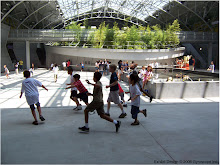
Here's something I forgot to mention in my earlier post- the Milwaukee Art Museum has a new exhibit opening this month called Act/React: Interactive Art. It shows work by a lot of the current big hitters in that realm (Liz Phillips, Daniel Rozin, Scott Snibbe, Camille Utterback). This exhibit plays with what I think are the more traditional notions of "interactive". I love the fact that there are many shades of grey around what is an exhibit as well as what makes it interactive. That's keeping it alive and compelling. It also spans science, art, and design to name a few. It's the shared language that needs some reconsideration. I'm curious about what's worked for you. What kinds of terms have resonated with you when working with these ideas? What tends to help a shared development process move forward when talking about something ubiquitous and yet unique?
Showing posts with label museums interactive. Show all posts
Showing posts with label museums interactive. Show all posts
Tuesday, October 7, 2008
Quick follow-up to "Term Limits"
Here's something I forgot to mention in my earlier post- the Milwaukee Art Museum has a new exhibit opening this month called Act/React: Interactive Art. It shows work by a lot of the current big hitters in that realm (Liz Phillips, Daniel Rozin, Scott Snibbe, Camille Utterback). This exhibit plays with what I think are the more traditional notions of "interactive". I love the fact that there are many shades of grey around what is an exhibit as well as what makes it interactive. That's keeping it alive and compelling. It also spans science, art, and design to name a few. It's the shared language that needs some reconsideration. I'm curious about what's worked for you. What kinds of terms have resonated with you when working with these ideas? What tends to help a shared development process move forward when talking about something ubiquitous and yet unique?


Tuesday, September 30, 2008
Term Limits
 In my last post, I touched up on the idea that a simple environmental shift in an exhibit can serve as an "interaction" for a museum visitor. Oftentimes in our conversations with clients we run into problems with this term. It's become a ubiquitous descriptor for a museum experience- is a flip panel an interactive? What about pushing a button to watch a video? If I turn a page in a book, is that interactive? This interpretation can vary widely amongst individuals and institutions. Then there's what museum professionals think it is, the client, and, oh yeah... the visitor (do they care?). Whew. I'm lost. You've probably figured out that the reason I'm bringing this up is because I think it's time we agreed that "interactive" has become too inclusive, and therefore, too confusing a term. In his paper "Museums and their languages. Is interactivity different for fine art as opposed to design?" (2002), James Bradburne suggests that we suspend the idea of interactive for a bit, and consider what kind of activity you want in your museum (he goes on to answer the question, which I'll leave to you). This is a great way to start, because it forces you to define and then describe/articulate in greater detail what are the experiences we want our visitors to have. For example, if you want open-ended conversation, then the space you create for it will be as important as the exhibit itself. Or, if you want surprise, investigation, and discovery, then you'll consider more than just one exhibit standing alone in a gallery as part of that goal. So am I talking about the importance of environment on experience? You bet- but there's more to it. If what we hope to achieve for our visitors is a revelation, transformation, or education, then I think we need to be a little more articulate about this intellectual, emotional, or physical transaction we've been calling interactive. By defining the activities we want our visitors to be having in our institutions up front, then we have moved beyond what buttons to push or technology to use. We've started to create a considered world for that experience (even if that world is intentionally surprising or unexpected), and a fuller immersion into the ideas we're trying to expose them to.
Subscribe to:
Posts (Atom)

 Posts
Posts