Showing posts with label science. Show all posts

Tuesday, September 1, 2009

Design affects behavior? Sure!

Le Laboratoire[Guest post by Justine Roberts]

At Gyroscope we expend quite a lot of effort on this point, and it is not news to urban planners, public artists, environmental psychologists, or many educators. A google search of “design affects behavior” reveals articles on how design affects voting behavior, inmate behavior, and the feeding behaviors of cows. The significance of the influence of design on learning is perhaps most succinctly articulated by Reggio Emilia in the phrase “the environment is the third teacher” (after the parent and the classroom teacher).

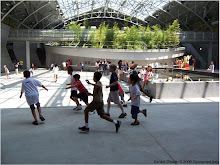
This past spring a new “gallery experiment” at Le Laboratoire, the art/science innovation space in Paris, explored how mood might influence design standards for housing. Studio R&Sie(n) and the mathematician François Jouve have created an experience in which they can measure the neurobiological responses of visitors (their mood) as they explore an on-going robotically built environment. At a sales desk “visitor/clients” were able to place an order for their bio-architecture to be implemented as part of the collective structure being created on-site.

Le Laboratoire is the brain-child of David Edwards and is designed to bring scientists and artists together through a series of year-long collaborations. The first exhibit documented the work of French artist Fabrice Hybert and Robert Langer of MIT who investigated intelligence. The second experiment paired Michelin-starred chef Thierry Marx and colloidal scientist Jerome Bibette who explored molecular gastronomy.

In the gallery visitors could have coffee served with a whiffer of chocolate. Le Laboratoire also released a product line of aerosolized chocolate for sale in the store.

Wednesday, March 25, 2009

Girls n Boys n Science Exhibits

maria mortati
Yesterday's suggestion that women may have a different engagement with science+technology than men meshes with some research we've been tracking here at Gyroscope:
"For decades, women have been chronically underrepresented in the sciences. More than two decades of research has uncovered a source of this bottleneck: real differences between how women and girls approach technology and the sciences versus men and boys. Women and girls tend to view technology as a tool for communication, companionship, and social utility, often focusing on what technology can “do” to improve the conditions of everyday living. In contrast, men and boys tend to view it as an object that will help them transcend the barriers."
- The Center for Children and Technology
Historically, science museums (through no fault of their own) have catered toward a more boy-centric approach to science exhibits. Think of phenomena rich, context "lite" traditional science exhibits. Turns out maybe girls just wanna have more... connection. We're working on what more gender-equal science exhibits might look like. Stay tuned for research and insights as we progress... and feel free to point us to any info you've found!

Tuesday, March 24, 2009

History of Gaming Meet the Future of Gaming?

jane mcgonigal, nina simon, Eric Wheeler, Jon-Paul C. Dyson, Marc Check, maria mortati The picture on the left made me laugh a bit because it's three white men in a pile of games. Not that I have anything against either of them. It's from the Strong Museum's National Center for the History of Electronic Games™ . The Game Museum:
"...collects, studies, and interprets electronic games and related material and the ways in which electronic games are changing how people play, learn, and connect with each other."
This photo DOES feel a bit historic to me, since my current (albeit limited) experience with games has been spearheaded, influenced, or introduced to me by women. The likes of Jane McGonigal (above center) and Nina Simon (above right) to be precise. At first blush, the change in women's approach to games seems to be about using games for a purpose, or harnessing social power. Such as Superstruct (figure out how to save the world from demise in 2019), World Without Oil (the name says it), and now game-meets-web2.0-thinktank: Signific.
Wonder what a history of gaming will look like in 20 or 30 years time?

Friday, March 6, 2009

An Exciting Merger Happening in Colorado

maria mortati A local history museum and local science center in Fort Collins, Colorado announced today that they have merged. What's Unique About It? The Fort Collins Museum is a publicly-owned, city entity. The Discovery Science Center is a private, non-profit. This partnership means that they will be a public/private museum. A powerful force in this economy. They also will be merging the staff of the two institutions, which means that they'll be meshing programming and exhibits- in essence, converging. For more info, go to: http://fcmdsc.org

Friday, February 20, 2009

Quick Post: Real-Time Animal Tracking Site

museums, science, TOPP, maria mortati I may be late to this game, but I just came across this site that might be of interest to science centers, anthropology museums, zoos, and aquaria. It's called TOPP (Tagging of Pacific Predators), and it offers a free live animal tracking widget which might be a nice add-on for your web site. There's a write up about it on the Stanford News site. Check it out. Oh, and if you've wondered what some of those tags might look like, check out this picture from the good folks at KQED's Quest TV show. They did a story on TOPP last year. What can I say, but better late than... museums, science, TOPP

Tuesday, October 21, 2008

Web 2.0 Sessions at ASTC

By Maria Mortati
I went to a few web-related sessions at ASTC that brought up some interesting questions and case studies.

Bryan Kennedy of the blog Science Buzz talked about the Body World Exhibit blog at Science Museum of Minnesota (SMM). They used the opportunity of the show to look at issues around body donation and asked questions of ethics (and beyond) via the blog. In using this example where they opened it up to be "messy", Bryan was trying to get the audience to consider what their comfort level is with things like controversy when setting up a 2.0 outreach tool.

Kevin Von Appen of RedShiftNow posed the question of "How do you make the virtual audience physical?" He gave a case study of a world wide YouTube event and subsequent real world "888torontomeetup" they held at Ontario Science Center, and how popular it was. While they didn't end up covering a lot of science, it brought in a new audience to their museum, and created a memorable (and heavily archived) connection.

Nina Simon of Museum2.0 gave a really fun example about how to do "tagging" in the real world. It's about a book drop in the Netherlands where folks returned books into one of two slots: average books and great books. She wrote a fantastic blog post about designing from a virtual metaphor to a real world experience.

Other topics covered, such as:
  • On a museum website or blog, should you make the "official" voice visible? (yes, usually)
  • In terms of child safety and museum sites, they suggested that you don't ask "problem questions" of kids during the log in to avoid issues such as COPPA conflicts later.
  • On extending the visit: the Franklin Institute (I think) has a face aging interactive on the museum floor that posts the picture on the web site. 75% of visitors log in from home to retrieve it. What a great opportunity for them to ask provocative questions about their thoughts on aging, plastic surgery, you name it. You could enrich AND extend the museum experience.
In the session Making Exhibitions Memorable that I cartooned about yesterday, Renato Valdes Olmos discussed how exhibits have permanence, but little reach outside the museum walls. He reinforced the importance of following those who are blogging or flickring about your exhibits, because again, that extends their reach, and leaves a record. He brought up the artist Banksy, who made a fictitious pet store exhibit and how word spread in a viral fashion via Twitter- which got people to go find it. That approach might not play out so easily for a science museum with a permanent collection-- the Banksy piece is a temporary art exhibit.

The thing I keep hearing is this: provide multiple vehicles for visitors to comment and spread the word about their experiences at your museum. Listen to what they are saying, and respond. The interaction itself will provide great fodder for expanding your relationship with your visitors, and in turn, your impact on their lives.

For me, this boils down to being open, hospitable, and responsive-- and utilizing web 2.0 to do it.

Saturday, October 18, 2008

Steven Johnson on "The Ghost Map"

Here's the Comic Life version of today's keynote: maria mortati, gyroscope inc, museums For more on the book, go to The Ghost Map.