[Hi, Scott posting again] To follow up on the material certification topic I started last week, this week I will be talking about Cradle to Cradle certification. "Cradle to Cradle" is a term coined by William Mcdonough and Michael Braungart to describe a pretty radical way of thinking about the life cycle of a product. Cradle to Cradle is about creating products that are designed for closed loop systems that create value and are healthy and safe. Often as a product moves through it's life cycle it goes through a dramatic degradation process and it's value becomes trapped in useless waste or worse yet it harms other natural systems as it is used. The bigger goal here is to design products that beneficial when they are used. He makes the point that growth in nature or a child is a good thing and so why can't growth related to development also be positive? This thinking turns the minimizing approach of sustainability it's head says that consuming product should play a positive role in our environment and society. The funny thing is that while this will require a radical reworking of the way we think about making and using products, it allows our consumptive urges to continue to run wild. For me, this is both the most promising aspect and the biggest danger. Our consumptive desire has been a tough one to shake (if not impossible) and while the bright future of good products sound great, in the short term we will have to do less. Anyway William McDonough along with Michael Braungart have written a really good book covering this approach and have followed that up with a certification program that evaluated products against their criteria. Mc Donough's website has videos and writings that are worth spending some time on. One interesting development with the LEED certification is that the next version (New Construction V2009) it will contain life cycle assessment as part of it's criteria. I will be interested to see if they start embracing ideas similar to Cradle to Cradle and then I wonder how such a potentially wide reaching idea will impact their other criteria.
Showing posts with label planning. Show all posts
Showing posts with label planning. Show all posts
Friday, December 12, 2008
Museums Now: Museum + LEED Friday: making sense of certifications [Part 2]
[Hi, Scott posting again] To follow up on the material certification topic I started last week, this week I will be talking about Cradle to Cradle certification. "Cradle to Cradle" is a term coined by William Mcdonough and Michael Braungart to describe a pretty radical way of thinking about the life cycle of a product. Cradle to Cradle is about creating products that are designed for closed loop systems that create value and are healthy and safe. Often as a product moves through it's life cycle it goes through a dramatic degradation process and it's value becomes trapped in useless waste or worse yet it harms other natural systems as it is used. The bigger goal here is to design products that beneficial when they are used. He makes the point that growth in nature or a child is a good thing and so why can't growth related to development also be positive? This thinking turns the minimizing approach of sustainability it's head says that consuming product should play a positive role in our environment and society. The funny thing is that while this will require a radical reworking of the way we think about making and using products, it allows our consumptive urges to continue to run wild. For me, this is both the most promising aspect and the biggest danger. Our consumptive desire has been a tough one to shake (if not impossible) and while the bright future of good products sound great, in the short term we will have to do less. Anyway William McDonough along with Michael Braungart have written a really good book covering this approach and have followed that up with a certification program that evaluated products against their criteria. Mc Donough's website has videos and writings that are worth spending some time on. One interesting development with the LEED certification is that the next version (New Construction V2009) it will contain life cycle assessment as part of it's criteria. I will be interested to see if they start embracing ideas similar to Cradle to Cradle and then I wonder how such a potentially wide reaching idea will impact their other criteria.


Friday, December 5, 2008
Museum + LEED Friday: making sense of certifications [Part 1]
 [Hi Scott Moulton posting.] With all the focus on "green materials" I thought it would be useful to talk about a few of the certifications that relate to materials . I'll start this week with certification for wood. Ok first I'd like to make a pitch for solid wood. It is a beautiful, durable, natural material that can be sustainably produced and will biodegrade. After building furniture with it for about 10 years I am still totally enamored with solid wood. (plywood is another matter) So if you are like me and want to use wood and wood that is sustainably forested you will be seeing the logos of FSC and SCS and trying to make sense out of what they mean. The Forest Stewardship Council is an independent, non-governmental, not for profit organization established to promote the responsible management of the world’s forests. They are the ones who set the most widely accepted standard as to what it means to call something sustainably forested. They have established 10 Principles and 57 criteria that address legal issues, indigenous rights, labor rights, multiple benefits, and environmental impacts surrounding forest management. I've always been impressed by their commitment to a rather broad interpretation of what sustainable forestry means. A lot of the exotic woods come from some troubled regions of the world so along with ecological concerns come some even more serious issues around the impact this trade has on the local people. SCS stands for Scientific Certification Systems and they provide independent third party certification for everything from coffee to flowers. You can see a wood product with both the FSC and SCS logos or only one which has always been a bit confusing to me. The thing to remember is that SCS is primarily a company that verifies environmental claims and performance based certification. So SCS verifies that a forestry practice adheres to the guidelines set out by FSC. Now things get messy because SCS also has their own competing guidelines which they will then verify and you can have the SCS logo show up. In addition, they offer Chain of Custody Certification, Life Cycle Assessment (I'll get into this next week) and single attribute certification for terms like salvaged recycled recovered and so on. All of this points to the interesting fact that while FSC certainly has established itself as the standard, there are differing views on what "certified wood" can or should mean. It is worth investigating the SCS website. I'm still trying to get my head around the extent of everything they are involved in and it raises interesting questions. Is it ok that these "independent third party" folks are also helping Starbucks and Home Depot set up eco guidelines that they will then use as marketing? While it may not be the purist path, I think this work with huge corporations is a really promising development. As ecological concerns become mainstream they will become part of our broad economy the commitment to verification and standards is critical to preserving some meaning behind terms like of "eco, sustainable, or green".
Friday, October 31, 2008
Museums + LEED Fridays: Green Exhibits?

[Note: Scott Mouton recently posted this note on the ASTC Listserv in response to a discussion about "green" exhibits. I thought it was an excellent discussion of what LEED credits mean in this context. -Maria]
On a basic level LEED is a way to quantifiably measure a building's performance in relation to the criteria set out by the USGBC. Buildings are LEED certified but not products, materials or people. This is not to say LEED has no bearing on exhibits. There are ways that exhibits can contribute towards points and the credit intents are a great way to inform a sustainable strategy for exhibits.
One thing that often gets confused is that materials can contribute towards a credit but
they are not in and of themselves certified. This might seem nit picky but it actually brings up an important aspect of LEED. The system evaluates the entire project based on a set of criteria that is a bit complex and often times contradictory. This complexity within their system is necessary and good.
As soon as you try to say something like "plyboo is a green material" things get complicated. It is a rapidly renewable resource but it also comes from China so it requires a great deal of energy to ship. At almost every turn you can find more questions than answers when trying to find something that is unequivocally "green". Instead of focusing on absolutes, LEED established a clear intent for each credit and then the sum of the credits gives an indication of the overall performance with regard to the environment.
For instance LEED has a credit for using rapidly renewable resources for 2.5% of all the construction materials (plyboo applies here) and it also has a credit for using regional materials for 10% of construction materials.
As the conversation about what make an exhibit "green" evolves, I hope it will broaden beyond material choices and focus overall sustainable strategies. As was raised in an earlier note, there are so many ways to look at this issue. Focusing on the entire life cycle of an exhibit will give you a different set of criteria (and thus end result) than if you were focused on carbon footprint. How do we establish this criteria and then what does it say about us? What are we willing to overlook, what tradeoffs are we willing to make?
So far the discussion has focused on the built object, but there is also the content of an environmentally focused exhibit to think about and how to engage the visitor in these issues. The social space of the museum could also offer unique ways for visitors to experience the aggregated impact of their decisions and sense community that can come from acting collectively.
Oh, and my choices for countertops typically *marketed* as green are:
- sustainably forested wood (if it is an appropriate application)
- Colorlith (recycled pulp in concrete)
- Recycled glass (if you can afford it)
-Scott
Monday, October 13, 2008
Exhibit or Exhibit Platform: which is right for your museum?
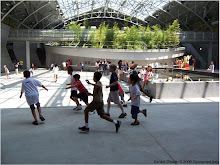
 What is an "exhibit platform" you ask? That's when an institution has an infrastructure that has been designed to support rich and changing experiences, programs, or activities. So, when is it appropriate to use "exhibits" and when "exhibit platforms"? I’ll demonstrate: In 2002, Gyroscope teamed up with the staff at the California Science Center to develop the Amgen Center for Science Learning (otherwise known as the Big Lab, pictured above left). This beautiful armory was refurbished to serve a nearby school. At that time, we were in the design development phase of the Bishop Museum Science Adventure Center- an addition to their natural history institution. In the case of the Big Lab, there was a school group that was coming on a daily basis. So one-hit wonders (even if they were working with phenomena) were not going to sustain the learning experience. The teachers and students needed an inter-changeable system that they could plug and play different lessons and activities into. This became an "Exhibit Platform" approach (think set design, to an extent). The Bishop has an amazing collection, and needed to serve a large audience of Hawaiians and global tourists. As a result, they had very different operating requirements from CSC. This global audience is often a one-time visitor, with school groups coming on occasion. While they were describing what was unique to their "local" environment, it is so diverse and well-known, that it was well-suited for high impact exhibits. In addition, the Bishop needed more permanent exhibits because it was going to be a long time before they would have funding again to renovate. Keep in mind from start to finish, the Science Adventure Center took 15 years! Traditional exhibits can be spectacular, iconic, and memorable experiences. They can also be expensive, complex, and as a result, permanent. In this quest for museums to compete for positioning to be the "3rd Place", total exhibit permanence is not always the appropriate solution. The exhibit platform model is useful for zones in a large institution with a need for changing programming or community museums where exhibit maintenance funding is limited, there is a good facilitation staff, and most importantly, repeat visitors. It's a great approach for flexible learning and play. Other museums where we have had success with this approach includes the Chicago Children’s Museum Skyline Exhibit, which I’ll talk about in a future posting. Up next: what makes a great master plan?
Subscribe to:
Posts (Atom)

 Posts