Showing posts with label "gyroscope". Show all posts

Monday, March 8, 2010

Tempe History Museum Opening: part II

By Ron Davis, Principal, LEED AP
With all museum projects there are challenges, and with this project, a tight budget. It is to the team’s great credit that so much was accomplished; by ingenuity, necessity and fortunate timing– to have been funded by the city during booming times, and then building the project during a down economy.

But the biggest factor was the cooperation, collaboration and sense of common purpose of all those involved: Architect Phil Weddle and his team, General Contractor Brignall Construction, Exhibit fabricators Motif (now Icon) and the many specialists in their employ, the City of Tempe and most of all to the museum staff. They were responsible for the vision, thematic development, research and many aspects of the installation, in addition to de-mounting the old exhibits and artifacts.

In this profession, there is nothing more satisfying than seeing the years (literally) of planning, discussion, cost cutting decisions, design, fabrication and installation culminate in a large crowd watching the ceremonial ribbon-cutting then entering the museum for the first time– filling up the exhibit hall to capacity!

Image: Gyroscope Inc.

Thursday, March 4, 2010

Tempe History Museum Opens!

By Ron Davis, Principal, LEED A.P.
This past weekend was the opening celebrations for the Tempe History Museum in Arizona. This local history institution has been re-born after undergoing a near-total renovation of the architecture and completely a new set of exhibits. Gyroscope Inc., working with Weddle Gilmore Architects, was selected to help the museum re-imagine the existing facility: a re-purposed library building, last renovated in the early 80’s. 

What had been a dark interior with the original 1980’s exhibits was completely stripped back to the bones. Natural daylight was allowed to flow back in and illuminate the wide-open spaces of the existing structure and new entry addition.

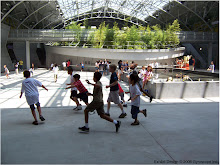
Among the project goals were to create inviting spaces and experiences for all visitors, including families. The fabulous turnout for the opening day brought a full spectrum of these visitors; from kids in strollers to octogenarians. 

Some people recalled the former exhibits and remarked on the transformation, others were making their first visit, and will be back very soon. It was tremendously gratifying to see the response.

Image: Gyroscope Inc.

Finally, Facebook!

Gyroscope has launched its own Facebook page.  Yes, now you can read this blog there (as well as here), or find out about other projects, news and articles we are following. We're using Facebook to capture cool links, interesting leads, and news.  We'll also post photo albums with project images that document our process and give you a sneak peek of our latest projects.

Monday, December 14, 2009

More about Green Design in Tempe


By Scott Moulton, LEED® AP

[This is a follow up on a previous post on Tempe Historical Museum.]

Beyond the material specifications, another key sustainable strategy we used for Tempe Historical was to design a system for displaying artifacts and telling stories that was easily reconfigurable. The limitations of a single purpose exhibit often lead to a short life span and staff being constrained by whatever assumptions the designers were working with.

For this client we came up a modular design let the museum re theme their exhibits and adapt over time. One design is a system of platforms that support interchangeable graphic stands, artifact displays, and flip books which include visitor's stories. The platforms ties all the modular parts together into a cohesive exhibit and become an organizing element for the museum.

One challenge for this modular approach is creating the appropriate level of interchangeability. A system can become burdened by it's own flexability at a certain point taking on too many features that may never be used. For Tempe we worked hard to insure they had a framework to support the change but the primary goal was to present the artifacts and local history in a compelling way.

Monday, November 30, 2009

Night Owl Lessons


By Maria Mortati

Quasi-confession: I've been tinkering with exhibits in my spare time.

At Gyroscope we excel at long-term planning. By day, I'm involved in researching, development, and advising people. As a result I'm constantly being exposed to new ideas and movements. Sometimes I want to test them out- how easy or hard is it to do this? Is it feasible? Over time I've been developing small exhibits to get instant feedback. I’ve put furniture into an art gallery, prototypes at a fair, and a "museum" into a park (some of these projects were collaborations).

One of the things I have found so far is that the complete lack of context fosters impact. I put exhibits (more or less) in the "visitors" environment, so their natural curiosity gets them to engage. It also means that the "visitors" are more dependent upon graphics to help them make sense of what they are encountering. They are working harder to get the to why is this here? What is the story? Why are these things together? Having an answer that is clear, yet not simple-minded has been effective. Whether that is written by me or in the first-person voice of the “maker” doesn’t matter.

These non-museum museum-goers are happy that these exhibits came to them, they didn't have to pay, or schlep their kids in the strollers and park their cars. They are excited to be given the chance to experience something "cultural" unexpectedly, and let me know.

With good cause, we spend years developing museums & exhibits. However, it’s fun to just build something and try it out. It may or may not "succeed"... but you'll always learn something you can apply in the long haul.

My Christmas Wish List


by Scott Mouton, LEED AP

Lyn Wood the president of  Hands On! contacted us here at Gyroscope to be a part of an article on the complexities of green design. I am hoping that this  conversation grows and that through it we can better understand the role, responsibilities and opportunities we have as designers.  

Over the course of our talk I realized that what was emerging for me was a wish list of of tools for communicating with with clients and visitors on the subject. So in the spirit of my son's Christmas wish list, this is what I'd like:
  • An easy way to describe what criteria is being using to make design decisions (There are so many flavors of green and we don't know how to describe them)
  • A way to frame our work as doing good rather than doing less bad.
  • A way to quantify the impact of some of our decisions.
  • A way for clients and visitors to understand the complexity but still be able to hold onto something as simple as "Green Design".
Over the next few weeks I'll be working through my thoughts on this. I would love to hear your ideas on what you think would help this conversation on "Green Design".

Image courtesy Library of Congresss, via Flickr.

Tuesday, October 27, 2009

Project Opening: Columbia Memorial Space Center


By Ron Davis, Principal and LEED AP

This past weekend marked the opening of the Columbia Memorial Space Center in Downey California. Gyroscope has been working on this project from its inception five years ago, and we are pleased to have seen the very first visitors enjoy the interactive exhibits at the Center. 

Downey was one of NASA's technology and production facilities and grew out of the early aerospace industry there. Among its notable achievements was the development of much of the Apollo program space vehicles, and the crew compartment of the space shuttle. The project is named as a memorial to the astronauts who died in the disastrous re-entry of the Columbia space shuttle. Though history is featured, the intention of the Center is to showcase past, present, and importantly, developing technologies. With the goal of fostering interest in science and technology in its visitors.

At the opening events, there were many retired engineers who had participated in pioneering space science developments. These developments are visible just out the windows from the new Center. 

The encounter that struck me the most was a conversation with an Hispanic mother of an 8 or 9 year old boy who really wanted her son to be inspired to pursue his interest in science– knowing that it could lead him towards future opportunities in a career that might not only fulfill his potential, but perhaps someday allow him to make his own contribution to the world. She asked if she might be able to volunteer at the center, as well.


It is extremely satisfying to see this new city-funded and city-run institution reach so many in their re-emerging community– from the aerospace workers with stories to share, to the young adventurers of the as yet uncharted future.

Slideshow:


Press: