Showing posts with label "museums". Show all posts

Tuesday, June 8, 2010

Exploratory Science

While we're on the topic of supporting education, I thought I'd also post this TED Talk by Brian Cox. He is a physicist from CERN who is also a voicebox in the UK on explaining physics to folks.

It makes the point that the cost of exploratory science is... priceless:


"...for every $1 spent on the Apollo program, $14 came back..."

Tuesday, May 11, 2010

Staff time on visitor participation?


We wanted to check in and ask the general museum community how it's going with your visitor contribution exhibits. Things like post-it walls, maps, and other non-digital participatory experiences that require upkeep.

Has it had any impact on staff time? Maintenance? We'd love to hear from you.

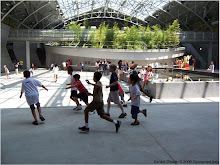
Image: National Constitution Center by Gyroscope.

Wednesday, April 7, 2010

This just in: "Arts Career Mushrooms in California" ?


Hopeful little article from "Live Career News" (I'd never heard of them either). They're saying that things are looking good in SoCal for museum workers. Statistically speaking, of course:
"The infusion of "new curatorial blood," the report says, reflects a "growing ethnic diversity and as well as fresh perspectives and programmatic growth," as the art world tries to lure back art patrons and enthusiasts."

Bring it.

Tuesday, March 16, 2010

NY Times: "Panel Proposes Single Standard for All Schools"

This article came out a few days ago from the NYT. It's something that could make our lives easier at the Master Planning and Exhibit Development level as we work to reinforce local vs. national education standards with exhibits.
"The new proposals could transform American education, replacing the patchwork of standards ranging from mediocre to world-class that have been written by local educators in every state."
This is an ambitious  goal and we hope that they are successful in making it work... and work well.

PS: as with any suggestion of systemic change there comes debate in case you have the time.

Thursday, March 4, 2010

Finally, Facebook!

Gyroscope has launched its own Facebook page.  Yes, now you can read this blog there (as well as here), or find out about other projects, news and articles we are following. We're using Facebook to capture cool links, interesting leads, and news.  We'll also post photo albums with project images that document our process and give you a sneak peek of our latest projects.

Friday, February 19, 2010

Museums Ought to be at the (Science) Fair

By Justine Roberts

Almost 3 months ago President Obama announced that there would be a national science fair next year.  I, for one, am really excited about this.  I think inventing is exciting, solving problems is creative, developing insights and knowledge is deeply engaging, and competence with making things is powerful.  Science IS cool.  Smart IS sexy. 

And the prize, by the way, includes shaking hands with the president at the White House. 

While I was working on the Exploration Station project, planned for Dublin, I became familiar with Ireland’s Discover Science and Engineering program (run through its Department of Enterprise Trade & Employment).  It too is designed to increase interest in science. But it is much, much more than an annual science fair.  In fact, science fair is Science Week during which time there are lectures, events, competitions and more.  In a country of 4 million over 100,000 people participate. 

One of DSE’s goals is workforce development – educating the next generation of innovators to drive Ireland’s economy.   So they have The Science Ambassadors program, which highlights Irish scientists working today and important historic figures.  Another goal is to increase the number of students in the pipeline.  Discover Primary Science provides teacher training, activity ideas, curriculum connections, equipment lists, and has an annual Award of Science Excellence program that schools can compete for. 

They also run 28 Discovery Centers where students can work on science activities outside of school.  This is like the field trip model we use in the States, but it is organized through the lens of promoting science and it coordinates science learning resources.  They have amazing partners including the Irish Seed Savers Association, and Dublin Zoo, just to pick 2 examples. 

But that is not all.  

They also produced 5 years of a TV series called Scope TV and they host a teen social networking site around science on bebo.  One of the coolest efforts has been Greenwave – a citizen science project to document the first buds on trees as spring sweeps across the island.   

Part of what is great about Discover Science and Engineering is that it has not been limited to one strategy or one audience.  Science, in this model, is for everyone, is accessible and serious, fun and deep, cool and media savvy.

Obama’s plan includes a set of programs not dissimilar to the types of things DSE has been doing.  He announced a series of public-private partnerships to develop science learning resources, such as interactive games.  And there is another piece of the Educate to Innovate program focusing on raising the profile of STEM by working with science rock-stars (like Sally Ride, the first female astronaut).  So I think it represents a good starting point. 

But there is one thing really missing from this picture: museums! We are an existing network of independent organizations working toward similar goals.  We should carve out a vital role. 

I see an opportunity to position ourselves as an on-the-ground network that supports science fair participants.  We could offer science fair workshops and summer camps, host open houses at which young scientists can present prototypes and get feedback, and act as hubs for information and resources to support local youth.  We can leverage existing programs – like the Rube Goldberg competition at the MIT Museum - and relationships to raise the profile of young innovators and scientists in our communities.  

Let’s get involved! 

Image source Creative Commons: quinn.anya / Quinn Dombrowski
 

Wednesday, December 2, 2009

Tinkering & Museums: Part 2


By Justine Roberts

So, why do museums like tinkering?

I started to think about what tinkering offers these museums and realized that it fits into where many science and children’s museums are heading. Tinkering helps to meet the needs of some important forward-looking initiatives:
  • Tinkering is intergenerational - Museums increasingly understand the importance of supporting adults’ active engagement and are looking for experiences that encourage adult participation.
  • Tinkering supports repeat visitors - It is an inherently rich, layered experience. It is easy to customize, and it supports long dwell times. This allows people with a range of abilities and levels of expertise to be successful.
  • Tinkering is interdisciplinary - Tinkering, with its combination of engineering, experimentation, technology, construction, and aesthetics has multiple entry points, is open to diverse play and learning styles, and can have many outcomes.
  • Tinkering develops skills - Whether taking apart an old toaster or building a robot the activity is process-oriented and fosters critical thinking. Such experiences encourage lifelong learning, which is increasingly emphasized by many museums.
  • It is authentic – Whether taking toasters apart or building robots, welding or sewing, tinkering uses real tools and materials. Often it is messy and it certainly could be a little dangerous!
  • Documentation and Reflection - While tinkering, visitors make things. These artifacts can be displayed to inspire others, or used to document the maker’s learning (see the Standards of Excellence report for more on this).
  • It supports constructive play - Tinkering emphasizes inquiry, science concepts, engineering and invention. There is room for imagination as tinkerers build scenarios around their creations. But it departs from more traditional immersive role-play exhibits.
  • Its good for business - Tinkering is also good for the business of museums. Tinkering’s mix of engineering, science, and creativity is highly fundable. It is seen as developing the innovative thinking critical to the 21st century workforce.
All together these aspects of tinkering describe a different type of museum, and one that helps position its users for success in the new economy in ways even they didn’t predict. 

Tuesday, December 1, 2009

Tinkering & Museums: Part 1


By Justine Roberts

Over the past month I have heard about tinkering on NPR, and read about hakerspaces – collectives that operate workshop/lab spaces - in the Wall Street Journal. I learned that Home Depot attributed a drop in profits to more people fixing leaky faucets, rather than replacing them. And my kids started asking to see Disney’s newest Tinkerbell movie, in which she completes her makeover from magical fairy into a creative and capable problem solver. "Tinkering" has become a popular American movement.

Fixing what you have, and saving spare parts, is what my grandparents’ generation did too, coming out of the Great Depression. One of the differences today is the DIY movement represented by Make Magazine, The Tinkering School, and even the quirky Slow Media folks. It was really just a matter of time before tinkering moved from the margins into the center.

What really made me stop and think was the realization that museums have been out in front on this. Just to pick three examples: The Austin Children’s Museum has a Tinkerer’s Workshop and a Maker Kids exhibit (and was involved in the MakerFaire/Austin); the Exploratorium’s newest ExNet exhibit is on Tinkering; and Explora offers exhibits like Systems In Motion and My Chain Reaction.

Next: Why Do Museums like Tinkering?

Monday, November 30, 2009

Night Owl Lessons


By Maria Mortati

Quasi-confession: I've been tinkering with exhibits in my spare time.

At Gyroscope we excel at long-term planning. By day, I'm involved in researching, development, and advising people. As a result I'm constantly being exposed to new ideas and movements. Sometimes I want to test them out- how easy or hard is it to do this? Is it feasible? Over time I've been developing small exhibits to get instant feedback. I’ve put furniture into an art gallery, prototypes at a fair, and a "museum" into a park (some of these projects were collaborations).

One of the things I have found so far is that the complete lack of context fosters impact. I put exhibits (more or less) in the "visitors" environment, so their natural curiosity gets them to engage. It also means that the "visitors" are more dependent upon graphics to help them make sense of what they are encountering. They are working harder to get the to why is this here? What is the story? Why are these things together? Having an answer that is clear, yet not simple-minded has been effective. Whether that is written by me or in the first-person voice of the “maker” doesn’t matter.

These non-museum museum-goers are happy that these exhibits came to them, they didn't have to pay, or schlep their kids in the strollers and park their cars. They are excited to be given the chance to experience something "cultural" unexpectedly, and let me know.

With good cause, we spend years developing museums & exhibits. However, it’s fun to just build something and try it out. It may or may not "succeed"... but you'll always learn something you can apply in the long haul.

Wednesday, November 11, 2009

Art/Science – Why Now?


By Justine Roberts, Principal
This week I attended the opening reception for The Laboratory at Harvard. As an science and art venue The Lab joins the following:
All of which have opened in just the last 2.5 years. That list does not include the discovery centers and children’s museums – such as the Austin Children’s Museum - repositioning themselves as places that bring art and science together. This incredible international explosion of interest in mixing art and science together raises the question: Why now?

As far back as Pythagoras art and science were used together to interpret and represent an understanding of the world. The two were teased apart in the 19th century with some clear benefits, as well as the rise of some new anxieties. Yet the division stuck. So why are we now working to reconnect art and science in popular culture, professional practice and the academy?

It is possible that students who want more opportunities to work across disciplines are in part driving these art/science projects. But not all of the venues are affiliated with a school, or focused on student participation. It is more likely that there is a cultural need for places that increase potential encounters with new perspectives, and which support unlikely collaborations between people from different fields. Michael-John Gorman, Director of the Science Gallery, thinks that today’s questions and problems require a new kind of creativity made possible only by interdisciplinary investigation.

If there is a critical need behind the impetus to engage the public in art and science together, then simply having the arts inform science and the sciences inform art is not sufficient. Not all artistic uses of technology, or visualizations of scientific data, are equally useful and enlightening. But it is not at all clear whether The Lab should therefore be a space for open exploration of art and science, or whether it should organize inquiry around a set of specific questions.

The Lab, like a number of the other art/science venues targeting teens and young adults, is designed to accommodate exhibitions, parties, lectures, and lounging. As described by its founders, The Lab was created to encourage conversation between the arts and sciences, with the goal of cross-pollinating ideas and fostering creativity. I came away from the opening reception questioning whether this was enough.

While I think it is critical that cultural space bring people together and serve as a catalyst for discussion and debate, I wonder whether The Lab could accomplish more. After all, as part of Harvard it has access to students and faculty as well as a large international network. It should be possible for The Lab to actively encourage collaborations and promote new solutions-oriented thinking. We will have to wait and see if The Lab is primarily a student exhibit hall, or if the University has a larger vision for it.

I think The Lab raises some important questions – for instance, how should we define “art” and “science” in the first place? And what is the common ground between them? Some people have suggested that art and science share a curiosity-driven process and a high degree of creativity. But others describe science as a way of investigating our world and art as unconstrained creativity. 

In the end, maybe the lack of clarity over what is art and what is science is the point. Although they require different training, ways of seeing, and starting assumptions, in practice the two might look very similar, making it possible for artists and scientists to share physical and intellectual space in a way that can open new opportunities for the future.

Monday, November 9, 2009

Nothing Like the Real Thing


By Maria Mortati, Sr. Exhibit Developer

Yes, yes, yes. The web is a wonderful tool. It provides for cost-effective virtual museum visits. When you’re talking about developing a shared vocabulary about spatial experiences however, nothing beats the real thing.

Last week we took a client on a “Bay Area Benchmarking” trip. We visited a diverse set of historic, art, science, and children’s museums.

This took many hours of discussions about exhibits and environmental relationships further down the field than any rendering or slideshow we have produced in the past.

Now our entire team has a shared vocabulary of experience around such intangibles as:
  • what the tone of a particular museum was like
  • how some interactives that sounded promising online are not as compelling in person
  • the importance of the arrival experience
  • power of materials and lighting 
...and more. This is especially important on museum projects where often you have non-spatial thinkers on a project team. They may not have the vocabulary or skills to articulate their needs, but put them in a spatial... wait, experiential context, and they become empowered.

So get off your internet and out into the world.

Monday, November 2, 2009

Scale & Context: a follow-up


By Scott Moulton, LEED AP
I was compelled to follow up on Maria's Scale / Context post. I love the way it points out both the way that design matters and has real consequence but also lives and dies by it's context or constraints. There is (or was?) a real interest in architecture to using the site as the starting point for a design. If you abstract that a bit and consider site as context, I think all good design starts from this point.

For me context includes the site or whatever existing point you are starting from, the social conditions and the client. It is the moment of deciding what you've got and what you should do that success of the project is determined. The Highline in NYC is a great example of this working. So is the good old Freitag Bag. In ways these can be seen as reuse/ recycling projects, but they go way beyond that. They are leveraging the world as it is to make the world as the designers want it to be.

Design should be more like jujutsu and less like boxing.

Friday, October 23, 2009

Environmental Impact on Exhibit Experience


By Maria Mortati, Sr. Exhibit Developer

This week, I was back at the EMP (Experience Music Project). I loved the fact that I could get my hands on real gear and PLAY. 

For those that haven't visited, there is an entire zone of the museum where you can try your hand at guitars, drums, keyboards in open "pods". You can also go into sound isolation booths and "learn to play", and record.

While that was super fun, it felt a bit finished and sleek an environment for a me as a novice. The contrast between the environmental design and what I brought to the table was... dramatic. Sort of like asking me to sculpt in the white galleries of the MOMA next to a Donald Judd.

The people that created the exhibits developed cool, cutting edge, custom work. Their innovations span the visitor experience/informal learning all the way through to design and technology. They fundamentally moved the conversation ahead for all of us with their innovations.  Yet it wasn't the exhibit interactives that, err, set the tone.

My experience started with the city this baby was born in, and the immediate neighborhood it was sited in. The funder and subsequent starkitect formed the environmental capsule and set the tone. 

Those top level considerations had huge impact my resulting experience- and it's important to note that translates to impact on learning, repeat visitation, and many other things many of us are passionate about. 

In my ideal universe, we  have those conversations early on, so that's what drives the bus.

Monday, October 12, 2009

Recommended Reading: Anything by David Carr


By Justine Roberts


I started reading David Carr while working on a community needs assessment for a library interested in adding a children’s museum to its core set of services. In thinking about the overlap between libraries and museums Carr’s perspective is unique and immensely valuable. I don’t know which came first - his nuanced understanding of libraries as centers of learning (compared with book repositories) or his insights into the needs of library users as learners reaching out at a critical juncture for resources and tools to help them move forward in their lives. The two ideas are intertwined in his work and Carr has written movingly about their implications for library practice, and library workers.

Early on, Carr recognized that libraries and museums shared some key characteristics that allowed lessons learned in one domain to serve as a useful lens for the other. As early as 1996 Carr was writing about the opportunities for libraries and museums to collaborate. Carr is intensely aware that libraries and museums are service-oriented, and he has a finely tuned understanding of how complex their users are and of the challenges this poses for the people working in them. In his writing Carr investigates the role of librarians as mediators helping learners successfully access the tools and information they need. He has extended this same critique to museum professionals.

Long before talk of web 2.0 and visitor-collaborations, Carr challenged museums to make more room for visitors: to ask questions, build bridges of understanding, and find their own uses for the collections and exhibits. In a talk he gave in 1998, reprinted in Museum News March/April 1999, Carr described his vision for museums as places designed to support visitors’ questions. He said:
“Questions always lead thinking. We find our way by questions, we found our way into things, and we find ourselves in things, all by asking what no one else can ask. The idea of helping people to ask the questions that only they can ask is at the heart of what can happen in a cultural institution: here people become more clearly the people they are capable of becoming, the people they were meant to be, by asking their own questions. And they do that with the museum’s help, and with the help of the objects they find in the museum, because in every object. . . something invisible is moving, inviting, provoking, leading the mind, leading the learner on.”
This vision still applies today. Allowing visitors to ask questions in an authentic (rather than rhetorical) way is at the heart of many recent more experimental exhibit techniques and strategies. And the behaviors associated with inquiry-based learning – including, in part, trial and error, experimentation, peer-to-peer learning, and conversation among visitor groups - seems to be increasingly at the center of our clients’ concerns as they work to realize their goal of serving as critically necessary resources for their local communities.