Showing posts with label "science fairs". Show all posts

Wednesday, March 3, 2010

Museums and Science Fairs: a case study

 
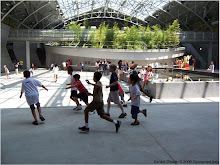
As promised, I thought I would offer a case study in this thread. I recently discovered that one of our clients, the Fort Collins Discovery Museum (back then, they were the Discovery Science Center) stepped in to rescue the Poudre School District science fair when it was about to be slashed from the budgets. That was 17 years ago.

With the local schools, the Museum now organizes, produces, and hosts the annual fair, using only their staff and resources. According to Jason Wolvington, Associate Director, they  focus the science fair on “celebrating participation vs. winning”.

Fair co-hosting has ideal mission alignment need for collaborative efforts. It’s a meshing of community & museum by doing the following:
  • it's keeping science fairs alive in their region
  • reinforcing the relationship between formal and informal education.
  • it's elevating the student's efforts by hosting it at a "special place" other than the school
  • it's reinforcing family connections between the Museum and the public
  • it’s building a future museum-going audience
This takes a lot of effort and some resources on the part of the Museum, but as both a community service and strategic opportunity it’s hard to poke holes in this logic. 

Just another reason why it's a great match for Museums to be at the National Science Fair table.

Photo courtesty of the Fort Collins Discovery Museum.

Monday, February 22, 2010

Museums & Science Fairs: follow up


On Friday, Justine posted about the President's plan to have a national science fair, and that museums should be at the table. She cited some great models of how this is already happening in Ireland, as a point of inspiration for the US. She just posted this follow-up:
"ASTC Informs just came into my mail box with this exciting note: 'The Inaugural USA Science & Engineering Festival is looking for participants in its October 23rd & 24th Washington, DC Expo and for additions to its list of satellite festivals being held across the country. The event is the country’s first national science festival, and the Expo on the National Mall will feature more than 500 U.S. science and engineering organizations, each with a different hands-on science activity. To register for the Expo, or to learn how you can organize a satellite festival at your own organization, visit www.usasciencefestival.org.'" 
While this may not be formally integrated into the President's program, this is an amazing undertaking, and ASTC is listed as a partner. 

I was curious as to who was behind it. According to their site, the fair was founded by Larry Bock, who is listed as "Festival Inspiration and Executive Director". He sounds like quite the science fair winner himself:
"Larry is a successful serial entrepreneur... He was the inspiration and executive director of the Inaugural San Diego Science Festival which was the world’s largest science festival of its kind... He and his wife have contributed $250,000 of their own money toward the effort. In addition, Mr. Bock is working fulltime on the Festival and is not drawing any compensation."
Wow.

Again, Museums don't appear to be a player in the President's STEM program of "Educate to Innovate". It looks as if it's primarily supported by public/private partnerships which leverage the core competency of the private partners (which is great). 

So I'm still left wondering how museums might participate in the national effort. There's a perfect match in terms of mission alignment, it's the cash that is the catch from what I can tell.

Next: Museums & Science Fairs: one city's case study

Friday, February 19, 2010

Museums Ought to be at the (Science) Fair

By Justine Roberts

Almost 3 months ago President Obama announced that there would be a national science fair next year.  I, for one, am really excited about this.  I think inventing is exciting, solving problems is creative, developing insights and knowledge is deeply engaging, and competence with making things is powerful.  Science IS cool.  Smart IS sexy. 

And the prize, by the way, includes shaking hands with the president at the White House. 

While I was working on the Exploration Station project, planned for Dublin, I became familiar with Ireland’s Discover Science and Engineering program (run through its Department of Enterprise Trade & Employment).  It too is designed to increase interest in science. But it is much, much more than an annual science fair.  In fact, science fair is Science Week during which time there are lectures, events, competitions and more.  In a country of 4 million over 100,000 people participate. 

One of DSE’s goals is workforce development – educating the next generation of innovators to drive Ireland’s economy.   So they have The Science Ambassadors program, which highlights Irish scientists working today and important historic figures.  Another goal is to increase the number of students in the pipeline.  Discover Primary Science provides teacher training, activity ideas, curriculum connections, equipment lists, and has an annual Award of Science Excellence program that schools can compete for. 

They also run 28 Discovery Centers where students can work on science activities outside of school.  This is like the field trip model we use in the States, but it is organized through the lens of promoting science and it coordinates science learning resources.  They have amazing partners including the Irish Seed Savers Association, and Dublin Zoo, just to pick 2 examples. 

But that is not all.  

They also produced 5 years of a TV series called Scope TV and they host a teen social networking site around science on bebo.  One of the coolest efforts has been Greenwave – a citizen science project to document the first buds on trees as spring sweeps across the island.   

Part of what is great about Discover Science and Engineering is that it has not been limited to one strategy or one audience.  Science, in this model, is for everyone, is accessible and serious, fun and deep, cool and media savvy.

Obama’s plan includes a set of programs not dissimilar to the types of things DSE has been doing.  He announced a series of public-private partnerships to develop science learning resources, such as interactive games.  And there is another piece of the Educate to Innovate program focusing on raising the profile of STEM by working with science rock-stars (like Sally Ride, the first female astronaut).  So I think it represents a good starting point. 

But there is one thing really missing from this picture: museums! We are an existing network of independent organizations working toward similar goals.  We should carve out a vital role. 

I see an opportunity to position ourselves as an on-the-ground network that supports science fair participants.  We could offer science fair workshops and summer camps, host open houses at which young scientists can present prototypes and get feedback, and act as hubs for information and resources to support local youth.  We can leverage existing programs – like the Rube Goldberg competition at the MIT Museum - and relationships to raise the profile of young innovators and scientists in our communities.  

Let’s get involved! 

Image source Creative Commons: quinn.anya / Quinn Dombrowski