Wednesday, June 9, 2010

Museum Futures from the Future of Museums

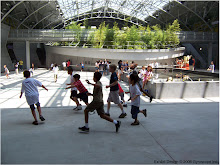
The Center for the Future of Museums recently published a report called "Demographic Transformation and the Future of Museums". It's a substantial tome which lays out the story for paying careful attention to who we think our audiences are now, and are becoming. "Majority Minority—What Will It Mean for Museums?" is a key section.

http://www.futureofmuseums.org/reading/publications/2010.cfm

There is lots of thought-provoking and inspiration for budget-setting material in there. Take a look. We'll be posting from time to time about it as we review the information and balance it against our experiences -looking backward and forward.

Image source: http://www.flickr.com/photos/pat_ossa/4336431744/

Tuesday, June 8, 2010

Exploratory Science

While we're on the topic of supporting education, I thought I'd also post this TED Talk by Brian Cox. He is a physicist from CERN who is also a voicebox in the UK on explaining physics to folks.

It makes the point that the cost of exploratory science is... priceless:


"...for every $1 spent on the Apollo program, $14 came back..."

April Rides for "Equity in Education"


We're not late, we're talking about our very own April Banks, designer extraordinaire, who is also an artistLast Friday, she left on an bike trek across the US with school teacher Kelly Clark for We Ride, a campaign to bring awareness to Public Education in America.

Why you ask? According to Kelly:
"This ride is about sharing the message of public schools being the backbone in every sector of any industry. Public schools educate the majority of us. Public schools should educate us well. Public schools are essentially the last remaining platform where all citizens have the right to attend/participate without any direct ‘out of pocket’ expense. Public schools are our opportunities to create healthy, productive, safe, and fair communities. Public schools are our chance to help children, families, and communities build a happier world."
If you would like to support their work, you can make direct donations or buy cool tee shirts at: http://www.weride3000.com/

Go April!

Wednesday, June 2, 2010

For Love Nor Money

Clearly, the economy is still suffering.  And in some ways it seems that new shock waves from the initial crash continue to radiate out to impact non profits.  After two years of cutting back on programming and looking for creative ways to save operating dollars, I believe in the next two years non profits will have to reach for other, more structural, types of solutions to mounting fiscal pressures.  


My concern comes from the ways state and local governments are attempting to balance budgets.  Government spending on the arts, education, and on culture is down, meaning that fundamental changes - with big implications for how museums do business - are still coming.  Not to put too fine a point on it: Nevada has cut over $4MM from arts spending, NY is proposing a 40% decrease in spending on the arts, and a bill in the LA House tried to eliminate the culture and tourism department entirely.  This goes beyond the tragic loss of public libraries in places like Boston and Charlotte, NC.

Necessity is the mother of invention 


Or so we have been telling ourselves for ~2,357 years.  This year, arts organizations and non profits are in a position to innovate . . .or else.  With that in mind, here are some initiatives that are attempting to invent new ways of supporting non-profits, and new non-profit/government/private industry relationships, that might prove interesting and useful in the coming months:


  1. Starting this past January the New Brunswick Arts Foundation began offering the first ever city bonds for the arts.  There will be 5,000 bonds, at $250 apiece.  Their hope is that people who would otherwise not be able to contribute will see this as a way to participate, and to make their contribution count.  The program will run for 5 years.  Once the total $5M is raised, $1M will go into direct funding and the rest into an endowment. 
  2. In Columbus Ohio arts organizations have begun outsourcing PR to a centralized group that specializes in arts management.  This is entirely voluntary - groups like the symphony have cut back so far on operations that they can no longer effectively market, raise money, or handle direct advertising.  Their program is already cut to the bone so there is a need for back office help to rebuild. The balancing act here is to enable arts organizations to focus on their programs - which only they can design and produce - while not completely divorcing them from management functions that are less unique.  
  3. Two cities we know of are working on a new kind of donor circle to introduce new donors to the experience of giving to arts and culture.  Part of the issue in these communities is that the existing donor pool is tired.  At the same time, younger residents with money do not have a tradition of philanthropy.  Getting these folks together in a giving circle creates a social context for donations. The group can challenge one another, and others in the community (perhaps their parents?!) to support a cause they have adopted.  Working with peers is fun and motivates participation. 
  4. In some cases, corporate groups are stepping into the gap left by government, grants, and private giving.  For two years in a row, Daimler has hosted an evening to promote the arts.  They see arts education as driving "diversity, innovation and creativity" not just in business but for whole communities. The role Daimler has chosen to play goes beyond fundraising. They have established a partnership with Cranbrook to hang student art in their offices, Daimler employees volunteer in elementary schools on community art projects, they have an artist-in-residence program, and they are hosting panels to raise visibility for the importance of arts education.  

What does this have to do with museums?


How do these experiments in creating new economic models for supporting non-profits relate to how museums are thinking about financial sustainability?

In the survey we did of Children’s Museums two years ago, we heard that children’s museums were not generally engaged in major restructuring. With a few exceptions they were not merging in large numbers with other organizations. Unlike Young at Art they were not typically co-locating with other groups to share capital and operating expenses.  

When I originally read these results I was surprised.  In part because we have clients that are working on exactly these kinds of issues.  But these organizations are trying to solve a set of operational problems.  As I think more about the mounting need to invent new revenue streams I am seeing an emerging need for a different set of solutions: the problem has changed.  


I think we will see more museums looking at an expansion of services into new areas, and experimenting with hub-and-spoke strategies designed to reach into the community in new ways, or acting as an umbrella, a producer, and a curator of people, events, and opportunities rather than keeping all of those functions in-house, and the creation of new membership/rewards plans and other ways to raise money.  I suspect that going forward we will see more organizations innovating at a structural level.  

Tuesday, June 1, 2010

Splinters from Green Design


Splinters from Green Design The Spring 2010 issue of the Exhibitionist features an article on the challenges of green exhibit design by Kathy Gustafson-Hilton. I was happy to be interviewed for the article and think it is critical to acknowledge the challenges of sustainable design in order to move from idealistic notions to a more sophisticated understanding of what sustainable exhibit design can be.

At Gyroscope, sustainability is a driving force in our design work. But we recognize the need for green strategies to be shaped by the specifics a project. Looking for the "perfect" green material (like interface flooring, which checks a lot of the boxes) leads to an impossible equation trying to balance carbon footprint vs economic impact vs resource management. Instead of focusing on these abstract equations we need to ask what the sustainable vision of the institution is and how (or if...) the visitor will experiencethat. 


This framework can serve as a structure for making difficult decisions and can also draw out opportunities to enrich the visitor's experience. There is an argument to be made that sustainable design in exhibits needs to be opportunistic and that it is only within the specifics of a project that "being green" can be realized.


I was inspired to recently hear Brenda Baker describe the new Madison Children's Museum and the way they have let their values and opportunities guide their design process to make what will be a truly unique place. Their commitment to the local community, and a tight budget, led to a decision to only use locally salvaged materials and and almost entirely local labor to design and build their exhibits. The flooring is from a local gymnasium, exhibits are made from local street signs, and there is an airplane found in a nearby forrest that acts as a table. I think they were offered the plane 3 months before their scheduled opening date - so the combination of their commitment and their creativity has been remarkable.

There are not many museums that are able to be flexible and nimble enough to handle this approach. In fact, there are not many BUILDING projects at all that can do this.  The Rural Studio has been consistently able to - but working on a shoestring budget and seeking innovation are in that program's DNA.


A unique physical plant that is a physical expression of the local community and also an embodiment of the organization's values, culture, and role in the community - to us, that's a great working definition of "green."