N. Elizabeth Schlatter, an expert herself in the realm of curating and museums, wrote a thoughtful article on new twists on "curating". While we don't curate here at Gyroscope in the strictest sense, we create institutions and platforms thata support all sorts of curatorial endeavors. It's a good read:
Showing posts with label curator. Show all posts
Showing posts with label curator. Show all posts
Friday, January 29, 2010


Monday, January 12, 2009
Denver Community Museum: a case study in pictures
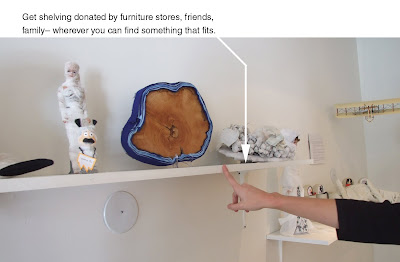
A while back I wrote a posting about the idea of the Denver Community Museum. Recently, I went to see it in person, and met with founder Jaime Kopke. I figured seeing it would be better than writing about it, so below are highlights in a "how to" format (in the hopes that it will serve as a point of inspiration). A more in-depth interview will be posted in coming weeks. For me, this had to be one of the most inspirational museum visits of 2008, and reinforced that easy-to-remember-not-always-easy-to-follow mantra K.I.S.S.:




Thursday, September 18, 2008
The 3 C's: Community, Creativity, + Critical Thinking
 Last spring, I participated in the MakerFaire in San Mateo, by putting together an exhibit called "The Power of the Prototype". It was a great experience for me, both personally and professionally. I came in contact with a broad swath of people that I might not have otherwise met in a museum setting. I learned a tremendous amount from this experiment. It got me thinking about how powerful that intersection of Creativity, Community and Critical Thinking can be, and how we might continue to foster it in the museum world. This is a topic I will definitely come back to from time to time. I attended my first MakerFaire in 2007 with other Gyroscopians. We wanted to evaluate some of the public programs there for a new institution we were working on called The Leonardo, in Salt Lake City. A large part of the concept we developed with The Leonardo was to fill the museum primarily with workshops, rather than exhibits. We wanted to encourage daVinci-esque thinking, by providing places where visitors could make things- be they artistic, scientific, or purely inventive.
  We also wanted to provide an area where they could share and show off their work. So we developed what we called "Community Looms". These were essentially wall dividers that displayed the visitor-made products. This, we hoped, would have the effect of elevating their work, both to themselves and others. We sought to create a cyclical effect (not unlike the MakerFaire) where visitors would be inspired by seeing people from their community creating and sharing their work, and thus, being a point of inspiration. The Leonardo is still in development, but we'd love to hear from others about their experiences with a workshop-based approach. Do you have a story to tell? Have you seen a workshop model that worked well (or didn't) for you? Up next on this topic: what makes the MakerFaire so successful?
Sunday, September 14, 2008
Visitors as Curators
 In an era where people can select the news they want to hear, they are making their own decisions about their experiences in museums and galleries. As we know, they can blog, comment, and even give each other context about what they experience. After all, it is their experience. The question for museums is how to help individuals make meaning out of these choices? How do you reach them? How do you validate their experience... and add to it? One answer is find out what people are saying. Give them ample opportunity to post what they think about your exhibits. For example, you could offer them the opportunity to respond with a multi-pronged approach, divided along favored types of input:
 - Tween/Teen set: you can offer a "text us at 555-1212", then post vetted comments online or in the museum
- Bloggers: you could advertise the blog for the museum or exhibit in-house and invite them to comment. Provide them with a terminal on-site so they can record their experiences immediately. You can moderate their posts, if necessary.
- Luddites: provide the greenest option of them all- a notebook (a real one, not a computer). Scan in their comments from time to time. Rip out the offensive ones or find a funny sticker to put over them.
Subscribe to:
Posts (Atom)

 Posts
Posts