Showing posts with label "critter salon". Show all posts

Monday, November 22, 2010

Looking Deeply in the Art Museum

By Maria Mortati

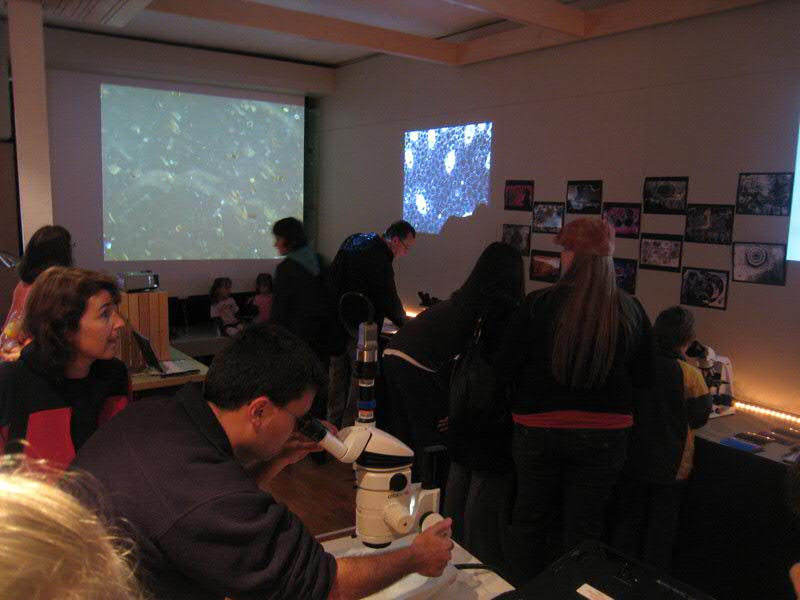
A few weeks ago, I again participated in an Enormous Microscopic Evening, this year at the Hammer Museum. It's an event created by the artist-run Critter Salon, and was supported by the Machine Project residency at the Hammer.

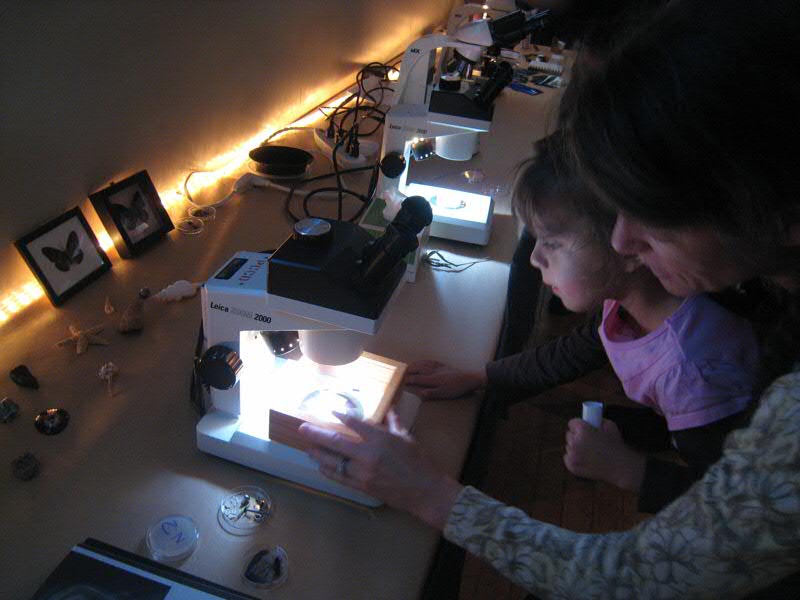
I ran the DIY Scope table, letting folks play and helping them assemble a variety of viewers from found objects. The audience was delighted that the Hammer was supporting this event, and I had countless folks asking me if they would "do this again".
Young participant chooses her lenses.
I've written a few times about the idea that artists make great public programmers. They are experts at exploring ideas and figuring out how to involve others.  The goal at this event was to "celebrate and demonstrate the range of equipment people are using to explore the invisible". Phil Ross, the force behind Critter, described the event as a "large microscope jam session".

The fact that this event was held at an art museum was a nice foil for Critter's objectives:
"CRITTER presents cultural events that focus on the way science is practiced in everyday life, taking form as talks, classes, demonstrations and workshops."
It underscored that point and caught an audience who typically comes to "look" in an art museum by surprise. Visitors were exposed to a variety of ways of looking and navigating in the barely visible, and often academic world.

It was a fantastic success. I had kids and adults coming back for more after making a loop around the room. The layout of which was arranged with the the DIY table in the center, with the full regalia of microscopists forming the edges. 

Feel free to visit the Flickr set by Machine Project here. Photo courtesy of Machine Project/Marianne Williams, poster by Critter Salon.

Tuesday, September 15, 2009

Artists as Public Programmers: for Microscopy?


By Maria Mortati, Sr. Exhibit Developer
Last weekend, I attended and participated in the most recent "Critter Salon" event put on by bio-artist Phil Ross. It was billed as the "Enormous Microscopic Evening", with microscopes and microscopers of all shapes, sizes, abilities and technologies.
It was FREE and the event was packed.
This was a great example of the power of providing multiple access points to a complex topic. It created excitement and fostered understanding while also celebrating the simple beauty of the practice of microscopy.
It also showed how an artist makes a great public programmer by bringing together disparate yet similar groups under one roof through their own interest and their ability to communicate.
In addition to being able to get hands-on with technology from the following groups...
  • Exploratorium’s Living Systems Department
  • Carnegie Institute for Science’s Department of Plant Biology
  • Fletcher Lab from UC Berkeley
  • SF Microscopical Society
  • Merritt College Microscopy Program
  • Thomas Zimmerman
...Phil also had a small "build your own microscope station" (which yours truly worked at). This was made up of 2 lightboxes, plants cut from outside, a glue gun and parts and lenses from disposable cameras Phil got from Walgreens. I made well over a dozen mini-microscopes for delighted kids and adults.
All photos courtesy of Phil Ross.

Friday, March 13, 2009

Artists as Public Programmers - is this about audience?

artist,  public program, museum, phil ross, critter salon, maria mortati


Building on the theme for the week of exploring the role of artists who “do” public programs, I began to wonder if this was a question of demographics and audience? I mean, look at the picture above- everyone is in their 20’s - 40’s, and possibly single or newly married.

Which got me to thinking about other public programs that aren’t held in museums which reach a similar demographic- science cafés. I love the idea, and went to a fun and informative science cafe session at ASTC last fall (I made a comic about it, you can find it, and DIY links here).

Ever since, I’ve been encouraging clients to pursue this particular audience through such a mechanism (going to them, or catering to their lifestyle). I mean, why should kids have all the fun?

It’s pretty clear that “in this economy”, folks are looking to do more with less, and closer to home. This could be a silver lining for museums- especially small ones. Take advantage of the moment and start a relationship with a local bar or restaurant. Start a science lecture series or art or whatever. Great resources and examples abound for how and why.

Which is what I think artists are doing. However, their interest isn’t geared so much at reaching a certain demographic-- that just IS their demographic.

Phil Ross wants to understand modern science, and as part of his process, he’s making it accessible.

Isn’t that what your museum wants to do?

Monday, March 9, 2009

Artists as Public Programmers?

phil ross, maria mortati On Saturday, I went to an event called "Clone Home". It was produced by the bio-artist Phil Ross at a flexible gallery/workshop space in San Francisco. It's part of a series of events called Critter Salon. The interesting thing is that he's an artist who is doing basic science outreach programs- and they're informal, engaging, and fun. You can see pictures of the event (and me, playing with plants, of course) here. I'm going to explore some of the questions and ideas this event raised in my mind this week. Such as, what does it mean if the programs are happening outside your museum? What need is that fulfilling?