Wednesday, September 23, 2009

What aesthetic does a prototype need?


By Maria Mortati, Sr. Exhibit Developer
Should a prototype exhibit or space in a museum feel as refined as possible, or like an experiment?

We've been working on this with a client who is starting to test out ideas (as well as themselves) through prototyping. The Fort Collins Museum and Discovery Science Center merged last year, and while they are in development of their new facility, they have moved in together. They are smartly using this opportunity to test out new ideas, their relationship, and inviting the public in to participate. 

One question that's come up is what should this look like? Does it want to look like a finished exhibit? 

Our recommendation is that it is more inviting for visitors if it feels like a prototype- leave things unfinished (but safe) and loose.  For example, print out graphics and clip them up, leave the walls bare white or unfinished. Clamp on lighting- you get the idea. 

This creates an environment where both ends of the relationship can take risks and have permission to mess up and iterate.

Our experience is that the visitor will be more open to raw ideas presented if they come into it as an invitation into your experiment. They can feel like they are a part of the process at the museum. Which they are.

You can also invite them to come back and be a part of the testing and development as things progress. A great vehicle for repeat engagement. 

We're excited to see how things progress, and we'll report back from time to time as things progress. This is going to be fun.

Tuesday, September 22, 2009

Piloting a Powerful Tool for Museums

[By Justine Roberts]

Increasingly, our clients are less focused on a new larger building, and more on shaping their existing organization to better address audience needs. We talk a lot about how to manage this type of transition – after all, the organization has an existing culture, way of working, and audience expectations that need to be navigated carefully. We believe you need a big vision and a coherent plan to guide change (as evidenced here, here, and here). But change itself can happen incrementally, through iterating.

Piloting, or iterating can help you build credibility, capacity, and a track record of success.

By “capacity” I mean internal, operational capacity, as much as I mean fund-raising capacity. It’s hard to change from the inside out, but it’s a mistake to think that it is easier to close the old museum one day and open a new site the next with the whole team ready to go.

Museums are not retail operations.

The learning curve during a change process can be steeper than anyone expected. Piloting, even when it pushes ideas forward in one department at a time, allows the whole organization to ramp up slowly. One of the real advantages of piloting is that the learning process happens within a safe space, is contained, and can be treated as a prototype in which experimentation and risk-taking are the rule.

Case Study: The Big Open-Source Strategic Project, Connecting Communities to Collections

There is a terrific example of this right now at the Shedd Aquarium in Chicago called the BOSS project. BOSS is funded by a 2007 IMLS grant designed to explore new ways to ensure programs meet audience needs.

BOSS takes a learner-centered approach in which community volunteers sit on planning committees with staff and co-develop strategic plans. As Melissa Williams, Assistant Director of Education, said:

You can make those calls for people, but its better when you are making them with people.”

In that spirit, BOSS brings community volunteers on board as full members of the planning team to design and implement new programs.

It’s still early.

BOSS is still early in implementation, and many key questions remain to be answered:

  • What are the mechanisms for sustaining new relationships with volunteer committee members?
  • Has this process changed volunteers?
  • Where can community volunteers have the biggest impact moving forward?

But Williams believes that the project has already demonstrated some key ideas. For one, Williams thinks BOSS is redefining what users expect from the Aquarium in ways that will enhance the organization’s long-term impact on users.

Internally the program has been a success, too.

BOSS project staff has embraced new ways of working, language to describe community relationships, and a new framework for evaluating programs. Williams says that the big lesson from the BOSS project is that “it’s about listening and collaborating.”

We are looking forward to seeing how the experience of this one project team continues to inform the culture of a large organization.

Wednesday, September 16, 2009

New Tool for Citizen Science?

[By Justine Roberts]

I am not someone who could be characterized as an “early adopter” of new technologies, even when they are whiz bang cool. But I do get excited about technology innovations that suggest new and deeper ways for museums to engage with their public. When I learned about Pachube I wondered: could museums leverage this relatively simple idea about how people, objects, and the web interact as part of a strategy to build on-going relationships with audience members around issues important to them?

Pronounced Patch Bay (the name references the function of an old fashioned switchboard) this open-source code connects people, via the web, to objects in the real world. These objects – or devices – have been outfitted with a sensor that can send data to pachube’s website. Data can be stored, aggregated with other data feeds tracking similar information or from linked devices, graphed, and shared. The connections are many-to-many, and happen in real time so that data streams can be sent to handheld devices, or updated on public websites as they change.

So why is this so exciting? I don’t really need to know if the snack machine on my floor is stocked with my favorite chips before getting up from my desk. And some of the ideas that pachube suggests on its website are a little “gee whiz” – like linking lamps in different cities together so that one turns on or off in response to the other.

But there are some new research potentials that this technology opens up both for professionals and – most relevantly for museums - for citizen scientists. Using pachube I can track, for example, my carbon footprint in real time, and also monitor my community’s energy use or pollution levels. In addition to pulling information in, pachube can send instructions out to its linked devices - for example, turning off the lights when the power grid is running at peak capacity.

Some citizen science projects – like the annual Cornell Backyard Bird Count, or the National Geographic DNA Project– require people to collect information manually, and rely on them to enter it into a database. Pachube is targeting a different kind of (automated) data collection, and at the same time making it easier to collect detailed, specific information. The addition of the smart networking function, which allows devices to be responsive to the data, also makes it possible for individuals (and organizations) to act on this information. Pachube is removing barriers to participation on both sides of the equation.

So how might museums use pachube?

Museums are ideally positioned as the hub of citizen science initiatives, and a number of museums are already experimenting with projects. In addition to serving as a community partner, they are acting as the central access point for hardware and software, and the host of the public interface that allows participants to see both their own data contributions and the big picture. In addition to bringing like-minded individuals into contact with one another, and organizing collective action, many museums see citizen science initiatives as an opportunity to serve as the host for discussion and debate around issues of critical importance to the community.

Pachube’s automation, ability to aggregated data, and emphasis on linking action to results, seems to have the potential to amplify the strategic goals of many museums to play a role as a top-of-mind local resource, and as a hub that links people and resources. It supports a type of activity consistent with museum’s missions, all in a way that is audience-centered and relevant.

How might you use it at your museum?

Tuesday, September 15, 2009

Artists as Public Programmers: for Microscopy?


By Maria Mortati, Sr. Exhibit Developer
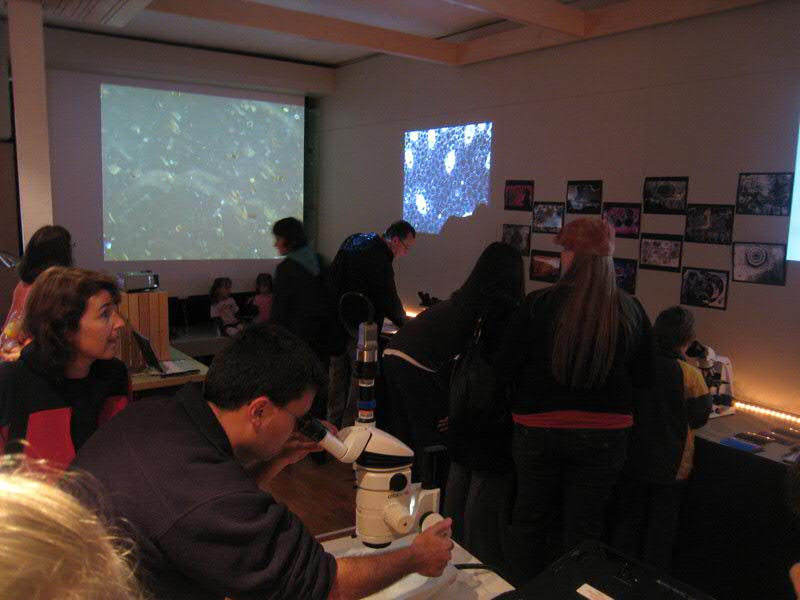
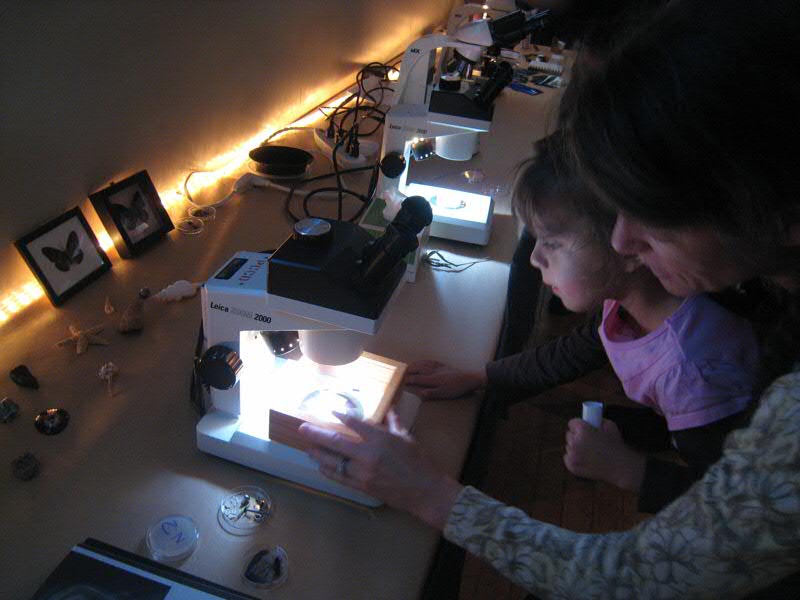
Last weekend, I attended and participated in the most recent "Critter Salon" event put on by bio-artist Phil Ross. It was billed as the "Enormous Microscopic Evening", with microscopes and microscopers of all shapes, sizes, abilities and technologies.
It was FREE and the event was packed.
This was a great example of the power of providing multiple access points to a complex topic. It created excitement and fostered understanding while also celebrating the simple beauty of the practice of microscopy.
It also showed how an artist makes a great public programmer by bringing together disparate yet similar groups under one roof through their own interest and their ability to communicate.
In addition to being able to get hands-on with technology from the following groups...
  • Exploratorium’s Living Systems Department
  • Carnegie Institute for Science’s Department of Plant Biology
  • Fletcher Lab from UC Berkeley
  • SF Microscopical Society
  • Merritt College Microscopy Program
  • Thomas Zimmerman
...Phil also had a small "build your own microscope station" (which yours truly worked at). This was made up of 2 lightboxes, plants cut from outside, a glue gun and parts and lenses from disposable cameras Phil got from Walgreens. I made well over a dozen mini-microscopes for delighted kids and adults.
All photos courtesy of Phil Ross.

Friday, September 11, 2009

Tools we use: social networking for museum projects

gyroscope[By Justine Roberts]

There are lots of networking sites out there that allow groups to come together and share information. Over the past 3 years we have been trying out various on-line tools with our clients. Two in particular have been successful in different contexts: Ning, and Wiggio. Here's why they are useful.

Facilitating deeper engagement from multiple stakeholders

There are many benefits of using a website to share information with a project team and stakeholders. As with an FTP site, we are able to post meeting notes and progress documents in a place that people can access them as needed. In addition, these sites allow us to post a link to an article or a potential partner organization, upload design references and personal photos of visits to other museums, and share personal profiles and background information on the interests and passions of team members. All of this allows fuller information sharing, helps the project team to build shared vocabulary, and keeps everyone informed of the progress and trajectory of the project.

But the biggest difference these sites make, and the place where we at Gyroscope are most excited about their potential, is in how they are able to shift communication from a structured event of passing information back and forth to an evolving and complex dialogue that is accessible to multiple stakeholders.

Elicit informed debate

By posting a link to an article on the future of artifact-based museums in an increasingly digital age we can elicit debate within a project team about the implications for their own institution. Different points of view emerge naturally in this setting, and the team is able to raise important questions on its own. With Gyroscope facilitating, rather than leading, these conversations the team develops better internal communication strategies and a fuller understanding of the issues and opportunities.

Keeping the conversation going on long-term projects

At the same time, the use of the on-line site has encouraged an on-going conversation that keeps participants actively engaged in the issues between major project milestones, and encourages individuals to come to the next meeting with ideas and questions.

We use many tools to develop partnerships with our clients. These on-line networking sites seem to enable projects to take root in a deeper way, where ownership of the ideas and strategies underlying the museum clearly lives in the community. And this is a key to sustainability and long-term success.