Wednesday, March 3, 2010

Museums and Science Fairs: a case study

 
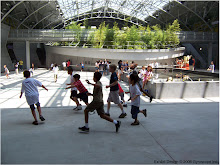
As promised, I thought I would offer a case study in this thread. I recently discovered that one of our clients, the Fort Collins Discovery Museum (back then, they were the Discovery Science Center) stepped in to rescue the Poudre School District science fair when it was about to be slashed from the budgets. That was 17 years ago.

With the local schools, the Museum now organizes, produces, and hosts the annual fair, using only their staff and resources. According to Jason Wolvington, Associate Director, they  focus the science fair on “celebrating participation vs. winning”.

Fair co-hosting has ideal mission alignment need for collaborative efforts. It’s a meshing of community & museum by doing the following:
  • it's keeping science fairs alive in their region
  • reinforcing the relationship between formal and informal education.
  • it's elevating the student's efforts by hosting it at a "special place" other than the school
  • it's reinforcing family connections between the Museum and the public
  • it’s building a future museum-going audience
This takes a lot of effort and some resources on the part of the Museum, but as both a community service and strategic opportunity it’s hard to poke holes in this logic. 

Just another reason why it's a great match for Museums to be at the National Science Fair table.

Photo courtesty of the Fort Collins Discovery Museum.

Tuesday, March 2, 2010

Museums & Science Fairs: Make Magazine Collaborations

And as many of you know, Make Magazine, the founder of Maker Faire (arguably the world's biggest science fair) has been collaborating for a while with science museums to have smaller fairs, "Maker" events, etc. The people behind Make have a deep, thrillingly unbridled passion for informal, hands-on learning.

For example, Make already serves as a hub for informal science fair groups of all ages, as witnessed by their list of  "Maker Community Groups and Spaces". They also have their own list of "Organizations that Promote Hands-on Learning" from around the world.

In 2008, they organized a program at Chicago's Museum of Science and Industry called "American Maker". It was billed as a "Show-and-Tell" Program to Showcase Grassroots Innovation":
"Make Magazine has portrayed the work of thousands of makers across America. Now we're looking to discover the most innovative makers whose work has the potential to benefit others. We've created a new event called American Maker... as part of the launch of Science Chicago, a year-long celebration of science."
They have been collaborating off and on with the Exploratorium in many ways, especially with their "Young Maker" programs:
"As part of the Young Makers program, the Exploratorium will host "Open MAKE" on the last Saturday of the month, beginning January 30th, continuing on February 27th and March 27th and concluding on April 24th.The goal of the program is to encourage kids to make, show them different things they can learn to make, and work with kids who'd like to bring some of their work to Maker Faire"
Sounds like a Science Fair to me!

Finally, this year will see Maker Faires in 2 cities hosted by the New York Hall of Science, and the Henry Ford Museum.

Friday, February 26, 2010

New Prezi: "How do you Build A New Museum?"

A client I've written about before (the Fort Collins Discovery Museum) put together a cool, thoughtful Prezi about their project. Check it out– especially if you're looking for a storyline of how a museum comes together:

We've been working with them since the beginning of the Master Planning process and it's been rewarding and fun. They are a talented, motivated bunch of people working in a supportive community. What a combo.

Thursday, February 25, 2010

Affirmation?

Fabulous staircase at the Museum of Contemporary Art in Chicago by MCA's Senior Designer Scott Reinhard. Photo courtesy of Creative Commons/Flickr/Mobilus In Mobili.

Monday, February 22, 2010

Museums & Science Fairs: follow up


On Friday, Justine posted about the President's plan to have a national science fair, and that museums should be at the table. She cited some great models of how this is already happening in Ireland, as a point of inspiration for the US. She just posted this follow-up:
"ASTC Informs just came into my mail box with this exciting note: 'The Inaugural USA Science & Engineering Festival is looking for participants in its October 23rd & 24th Washington, DC Expo and for additions to its list of satellite festivals being held across the country. The event is the country’s first national science festival, and the Expo on the National Mall will feature more than 500 U.S. science and engineering organizations, each with a different hands-on science activity. To register for the Expo, or to learn how you can organize a satellite festival at your own organization, visit www.usasciencefestival.org.'" 
While this may not be formally integrated into the President's program, this is an amazing undertaking, and ASTC is listed as a partner. 

I was curious as to who was behind it. According to their site, the fair was founded by Larry Bock, who is listed as "Festival Inspiration and Executive Director". He sounds like quite the science fair winner himself:
"Larry is a successful serial entrepreneur... He was the inspiration and executive director of the Inaugural San Diego Science Festival which was the world’s largest science festival of its kind... He and his wife have contributed $250,000 of their own money toward the effort. In addition, Mr. Bock is working fulltime on the Festival and is not drawing any compensation."
Wow.

Again, Museums don't appear to be a player in the President's STEM program of "Educate to Innovate". It looks as if it's primarily supported by public/private partnerships which leverage the core competency of the private partners (which is great). 

So I'm still left wondering how museums might participate in the national effort. There's a perfect match in terms of mission alignment, it's the cash that is the catch from what I can tell.

Next: Museums & Science Fairs: one city's case study